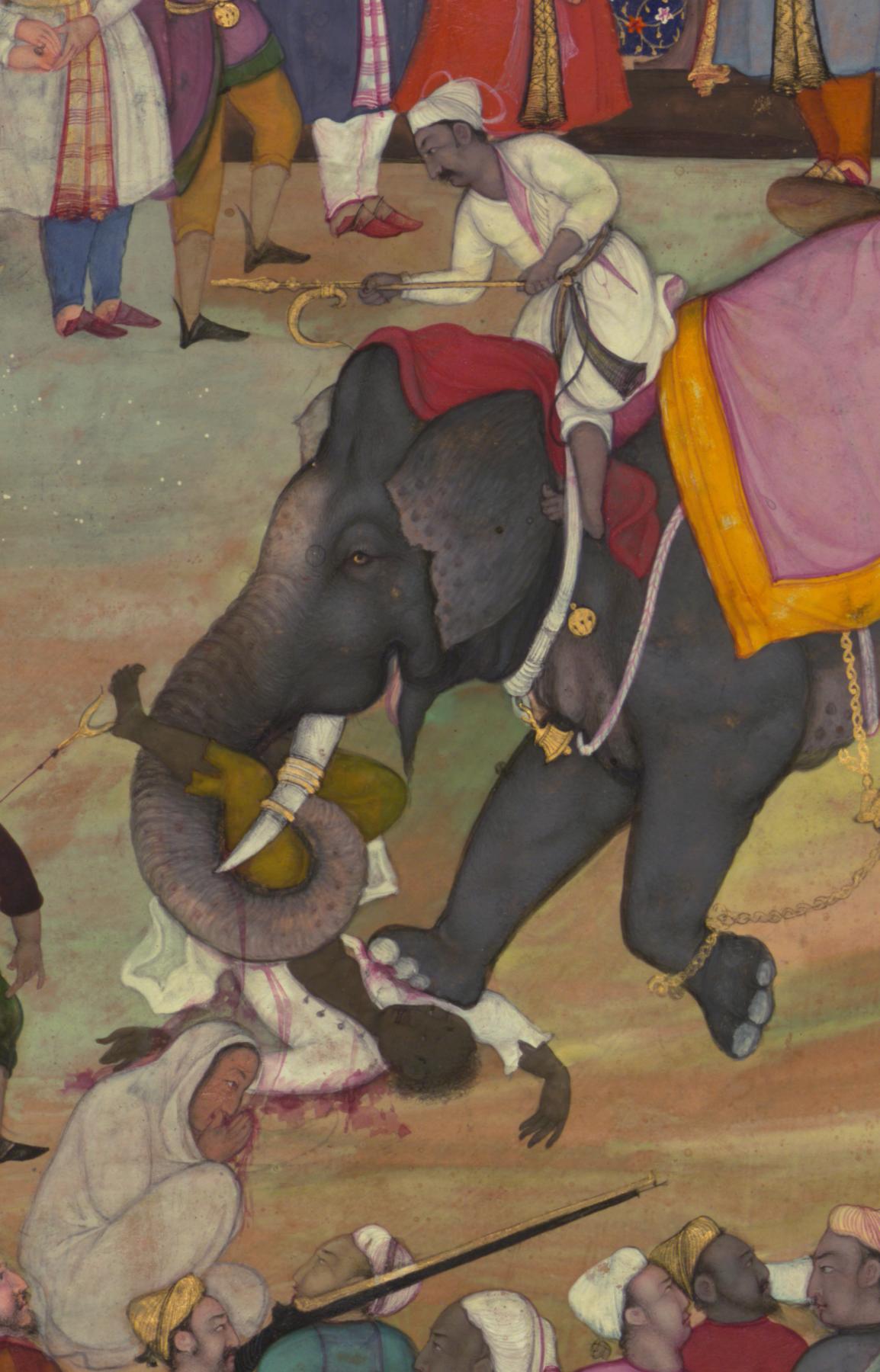
1. Elephants Were Not Just Tools — They Were Living Symbols of Life and Death Approved by Hindu and Muslim Kings
In the Vijayanagara Empire, Siam (now Thailand), Burma, and Malay sultanates such as Aceh and Kelantan, elephants were not just transport animals or symbols of grandeur in ceremonies. They were
the guardians between life and death. Historical records from the 13th to 18th centuries show that kings explicitly ordered special training for royal elephants — not to carry wood or dance, but to understand signals: one pressure of the trunk to press the chest, two sways of the legs to slowly step on the body, three taps of the foot to twist the victim's neck until it snapped. A Siamese royal advisor in 1657 wrote in
Phra Rajaphithi that 'an elephant that could not carry out the execution perfectly was considered to have lost
barami (royal virtue)'. In the feudal system of Asia, the king's power was not only to punish — but to
dominate what was uncontrollable: the wild. And the elephant, the wisest creature in the forest, became a clear proof that human power could subdue natural forces — even to the point of destroying lives.
2. Four Stages of Execution: From 'Last Honors' to Systematic Bone Separation
Execution by elephant was not a single process. It was a staged ritual — designed to maximize psychological impact on the audience and the victim. The Portuguese diplomat Duarte Barbosa (1516) recorded four phases commonly practiced on the Malabar coast: (i) The victim was brought to the field on a gold-ornamented and flower-decked elephant — as a 'last honor' before the punishment; (ii) The elephant was ordered to press the victim's chest for 3–5 minutes — enough to break the ribs and cause a slow death due to pulmonary embolism; (iii) If the king wanted to show maximum anger, the elephant would be guided to lift the victim with its trunk and throw it against a large stone — a record from the Bijapur Sultanate (1620) mentions 'the spine broke into three different parts'; (iv) The final stage, which was rare but the most horrifying: the elephant was trained to tear off limbs one by one — not wildly, but with surgical precision. A British doctor in Madras reported in 1792 that 'an elephant named
Chandragupta once separated the right arm, left leg, and head within less than 90 seconds — all under the guidance of its mahout's soft voice'.
3. Mahout: The Human Behind the Elephant's Power — Not Just a Guard, But a Professional Psychologist and Torturer
Mahouts — elephant handlers — were not just riders. They were elite figures trained since age 12 in
Gajashastra, ancient manuscripts on ethics, anatomy, and elephant behavior. In the Ayutthaya Kingdom, mahouts had to pass a three-stage exam: distinguishing 17 types of elephant cries (including angry, hungry, and killing cries), identifying 23 nerve pressure points on the elephant's skin to guide fine movements, and — most surprisingly — a moral test: they were required to kill a venomous snake with their bare hands as proof of 'unwavering resolve in execution'. Dutch archival records in Batavia stated that royal elephants in Java were often 'transferred between mahouts every 3 months' to avoid emotional bonds — because an elephant too attached to its mahout might refuse to carry out the punishment. A record from 1812 noted that 4 of 11 mahouts in Mysore were dismissed for 'being too sympathetic' after their elephants refused to trample a prisoner who cried out his child's name.
4. Why European Colonists Finally Stopped It — Not Because of Humanity, But Because of a Threat to Their Power
The British and Dutch did not stop elephant executions because of humanitarian values. Instead, records from the London India Office Archives (1835) clearly stated: 'This practice must be abolished because it gave symbolic power to local kings — power that could not be controlled by British Residents'. When King Tipu Sultan of Mysore used the elephant
Sarvajna to execute 23 captured British officers in 1782, he was not just taking revenge — but declaring that colonial power could be neutralized by traditional symbols. The colonists then introduced 'modern punishments': hanging in public, but under British iron poles — not under the shadow of a sacred elephant. In 1862, the Indian Penal Code explicitly banned 'using animals as execution tools', and royal elephants were reassigned to carry wood or participate in parades. However, the last recorded elephant execution was in Siam in 1895 — not for a criminal, but for an elephant that killed its mahout: it was executed
by another elephant, as a form of 'inter-species justice' that remains a mystery to this day.
5. Living Legacy: From Temple Statues to AI Technology Imitating Trunk Movements
Although this practice ended, its traces remain visible. At the Meenakshi Temple in Madurai, 17th-century relief carvings show an elephant pressing a man — not as a punishment, but as a metaphor for 'conquering desire'. In Bangkok, a bronze elephant statue in the Grand Palace still holds golden chains — a symbol of 'power binding sin'. More surprisingly: modern robotic technology imitates the mechanism of the elephant's trunk to create rescue robots that can lift victims from rubble without causing additional injuries. The MIT 2021 project used algorithms from movement records of elephants during executions — not for violence, but for precision: how one muscle could produce 70 different pressures in one second. History never truly dies. It only changes form — sometimes becoming myth, sometimes becoming machines, and sometimes, becoming a reminder: that true power is not in who kills, but in who can teach the wild to obey — and then, choose not to do it anymore.
---
Reference: Execution by elephant — Wikipedia
This Elephant Was Trained to Kill Slowly — Not a Myth, But a Recorded Historical Fact. Imagine an Asian elephant weighing 4 tons acting as a judge, executioner, and symbol of power all at once. This practice was not a movie scene or legend — it actually occurred for over 2,000 years in South and Southeast Asia. Records from Portuguese sailors, Dutch envoys, and British officials all witnessed it — and wrote with trembling hands. Why did kings choose elephants, not swords or gallows? And how could an animal considered sacred be turned into the most terrifying instrument of punishment in human history?. 1. Elephants Were Not Just Tools — They Were Living Symbols of Life and Death Approved by Hindu and Muslim Kings
In the Vijayanagara Empire, Siam now Thailand , Burma, and Malay sultanates such as Aceh and Kelantan, elephants were not just transport animals or symbols of grandeur in ceremonies. They were the guardians between life and death . Historical records from the 13th to 18th centuries show that kings explicitly ordered special training for royal elephants — not to carry wood or dance, but to understand signals: one pressure of the trunk to press the chest, two sways of the legs to slowly step on the body, three taps of the foot to twist the victim's neck until it snapped. A Siamese royal advisor in 1657 wrote in Phra Rajaphithi that 'an elephant that could not carry out the execution perfectly was considered to have lost barami royal virtue '. In the feudal system of Asia, the king's power was not only to punish — but to dominate what was uncontrollable : the wild. And the elephant, the wisest creature in the forest, became a clear proof that human power could subdue natural forces — even to the point of destroying lives.
2. Four Stages of Execution: From 'Last Honors' to Systematic Bone Separation
Execution by elephant was not a single process. It was a staged ritual — designed to maximize psychological impact on the audience and the victim. The Portuguese diplomat Duarte Barbosa 1516 recorded four phases commonly practiced on the Malabar coast: i The victim was brought to the field on a gold-ornamented and flower-decked elephant — as a 'last honor' before the punishment; ii The elephant was ordered to press the victim's chest for 3–5 minutes — enough to break the ribs and cause a slow death due to pulmonary embolism; iii If the king wanted to show maximum anger, the elephant would be guided to lift the victim with its trunk and throw it against a large stone — a record from the Bijapur Sultanate 1620 mentions 'the spine broke into three different parts'; iv The final stage, which was rare but the most horrifying: the elephant was trained to tear off limbs one by one — not wildly, but with surgical precision. A British doctor in Madras reported in 1792 that 'an elephant named Chandragupta once separated the right arm, left leg, and head within less than 90 seconds — all under the guidance of its mahout's soft voice'.
3. Mahout: The Human Behind the Elephant's Power — Not Just a Guard, But a Professional Psychologist and Torturer
Mahouts — elephant handlers — were not just riders. They were elite figures trained since age 12 in Gajashastra , ancient manuscripts on ethics, anatomy, and elephant behavior. In the Ayutthaya Kingdom, mahouts had to pass a three-stage exam: distinguishing 17 types of elephant cries including angry, hungry, and killing cries , identifying 23 nerve pressure points on the elephant's skin to guide fine movements, and — most surprisingly — a moral test: they were required to kill a venomous snake with their bare hands as proof of 'unwavering resolve in execution'. Dutch archival records in Batavia stated that royal elephants in Java were often 'transferred between mahouts every 3 months' to avoid emotional bonds — because an elephant too attached to its mahout might refuse to carry out the punishment. A record from 1812 noted that 4 of 11 mahouts in Mysore were dismissed for 'being too sympathetic' after their elephants refused to trample a prisoner who cried out his child's name.
4. Why European Colonists Finally Stopped It — Not Because of Humanity, But Because of a Threat to Their Power
The British and Dutch did not stop elephant executions because of humanitarian values. Instead, records from the London India Office Archives 1835 clearly stated: 'This practice must be abolished because it gave symbolic power to local kings — power that could not be controlled by British Residents'. When King Tipu Sultan of Mysore used the elephant Sarvajna to execute 23 captured British officers in 1782, he was not just taking revenge — but declaring that colonial power could be neutralized by traditional symbols. The colonists then introduced 'modern punishments': hanging in public, but under British iron poles — not under the shadow of a sacred elephant. In 1862, the Indian Penal Code explicitly banned 'using animals as execution tools', and royal elephants were reassigned to carry wood or participate in parades. However, the last recorded elephant execution was in Siam in 1895 — not for a criminal, but for an elephant that killed its mahout: it was executed by another elephant , as a form of 'inter-species justice' that remains a mystery to this day.
5. Living Legacy: From Temple Statues to AI Technology Imitating Trunk Movements
Although this practice ended, its traces remain visible. At the Meenakshi Temple in Madurai, 17th-century relief carvings show an elephant pressing a man — not as a punishment, but as a metaphor for 'conquering desire'. In Bangkok, a bronze elephant statue in the Grand Palace still holds golden chains — a symbol of 'power binding sin'. More surprisingly: modern robotic technology imitates the mechanism of the elephant's trunk to create rescue robots that can lift victims from rubble without causing additional injuries. The MIT 2021 project used algorithms from movement records of elephants during executions — not for violence, but for precision: how one muscle could produce 70 different pressures in one second. History never truly dies. It only changes form — sometimes becoming myth, sometimes becoming machines, and sometimes, becoming a reminder: that true power is not in who kills, but in who can teach the wild to obey — and then, choose not to do it anymore.
---
Reference: Execution by elephant — Wikipedia https://en.wikipedia.org/wiki/Execution by elephant