AI
Kandungan Ditaja (Sponsored)
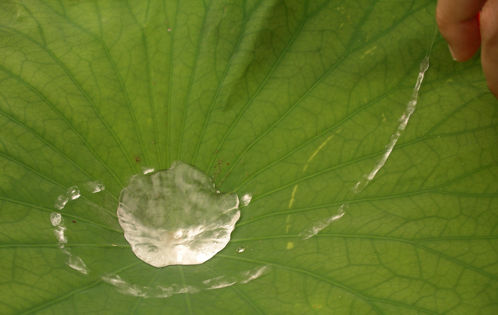
The Miracle of Lotus Leaf: Superhydrophobic Mechanism that Transforms Materials. The lotus effect, or lotus phenomenon, refers to the extraordinary self-cleaning property of the lotus leaf (Nelumbo) resulting from its superhydrophobic surface. Discovered scientifically by Wilhelm Barthlott in 1977, this phenomenon involves micro- and nano-structures that trap air and cause water to form spherical droplets that easily roll off while carrying dirt. This effect is not only found on lotus leaves but also on other plants such as nasturtiums and the wings of some insects, and has inspired various technological applications such as anti-stain paint, waterproof fabric, and medical devices.. Introduction: When Nature Becomes a Teacher
Have you ever observed how rainwater flows off a lotus leaf without leaving any marks? The water forms sparkling spherical droplets that easily roll off, carrying dust and dirt with them. This miracle is not magic, but rather the result of a scientific phenomenon known as the lotus effect or lotus phenomenon. Discovered by German botanist Wilhelm Barthlott in 1977, this phenomenon has revolutionized our understanding of surfaces and opened the door to extraordinary technological innovations. More than just a natural wonder, the lotus leaf is a nanoscale laboratory that has existed for millions of years.
Superhydrophobic Mechanism: Microscopy and Nanoscopy
To understand the lotus effect, we need to delve into a world that is incredibly small. The surface of the lotus leaf is not smooth like we thought. Instead, it is covered with a layer of epicuticular wax and adorned with thousands of microscopic papillae. Each papilla has a nanostructure that is even smaller. The combination of this hierarchy creates a surface that is extremely rough on a micro- and nano-scale. When water comes into contact with this surface, it cannot penetrate into the small crevices due to the high surface tension of water. Instead, air becomes trapped under the water droplets, creating a 'cushion' effect known as the Cassie-Baxter state. The water droplets then remain in the form of nearly perfect spheres, with contact angles exceeding 150 degrees. This state is known as superhydrophobic. Due to the low adhesion between the water droplets and the surface, water easily rolls off at a very small angle, carrying dirt particles with it. This is a perfect self-cleaning process, without the need for any chemicals or energy.
History of Discovery: From the Laboratory to Nature
Although the lotus effect has been observed since ancient times, its scientific understanding began in the 1960s. In 1964, two researchers named Dettre and Johnson conducted an experiment using glass beads coated with paraffin or PTFE telomer. They found that the rough surface produced a higher hydrophobic effect. However, a more comprehensive discovery was made by Barthlott and his student, Ehler, in 1977. They were the first to link the microscopic structure of the surface with the self-cleaning property. They named this phenomenon the 'lotus effect' after the lotus flower, which is the primary example. Since then, research has progressed rapidly. In 1986, Brown introduced superhydrophobic materials based on perfluoroalkyl and perfluoropolyether for applications in chemical and biological fluid control. Today, the lotus effect is the basis for various biomimetic technologies.
Not Just Lotus: Other Examples in Nature
Lotus leaves may be iconic, but they are not alone. Nature is full of examples of superhydrophobicity. Nasturtium leaves Tropaeolum and prickly pear cactus Opuntia also have similar surface structures. The wings of butterflies and flies also exhibit this property, allowing them to fly in the rain without being weighed down by water. Even the wings of some beetles have microscopic patterns that are not only hydrophobic but also structured to direct water to specific areas. This phenomenon is not just a coincidence. It is the result of millions of years of evolution to ensure that surfaces remain clean, free from pathogens, and function optimally. Each species has its unique variation, but the basic principle remains the same: a combination of wax and complex surface topography.
Technological Applications: From Paint to Medicine
The miracle of the lotus effect has inspired various technological innovations known as biomimetics. In the construction industry, superhydrophobic paint and coatings have been developed for buildings. Facades coated with these materials automatically clean themselves when it rains, reducing maintenance costs and the use of chemical cleaning agents. In textiles, waterproof and anti-stain fabrics have become a reality. Travelers and athletes can now wear clothing that is resistant to water and stains. In the medical field, superhydrophobic surfaces are used on medical devices and implants to reduce the risk of infection. Bacteria and other cells find it difficult to adhere to these surfaces, reducing biofilm formation. Even in the electronics industry, these coatings are used to protect devices from water and moisture. The potential applications of this technology continue to grow, with research in renewable energy, such as self-cleaning solar panels, and water harvesting systems.
Future: Challenges and Hopes
Although promising, superhydrophobic technology still faces challenges. Superhydrophobic coatings are often not durable. They can be damaged by friction, UV exposure, or high temperatures. The production cost is also high for large-scale applications. However, scientists continue to work on it. Current research focuses on developing more durable materials, such as hybrid polymers and silica-based coatings. Some are also exploring more affordable and environmentally friendly surface modification methods. The question arises: can we perfectly replicate nature? Or do we need to create our own version that is even better? Whatever the answer, the lotus effect has opened our eyes to the fact that nature is the most skilled architect. The small lotus leaf has taught us that cleanliness can be achieved without effort, just with clever design. And perhaps one day, we will live in a world where almost all surfaces are superhydrophobic and self-cleaning. That is not an impossible dream, given that we have already started walking on the same path.