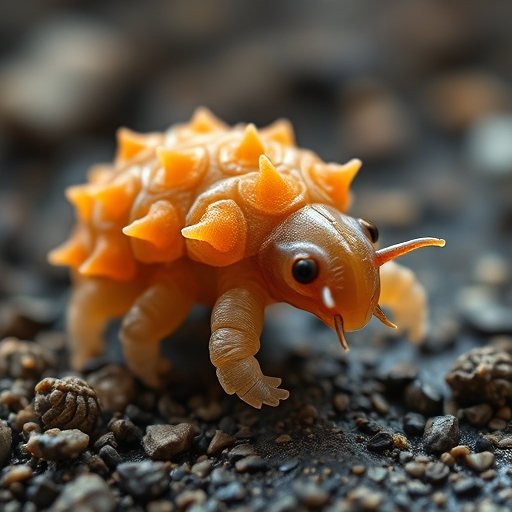
Introduction to Tardigrades: The Small Super-Resilient Creatures
Tardigrades, also known as water bears, are microscopic animals measuring between 0.1 and 1.5 millimeters in size. They were first discovered by German zoologist Johann August Ephraim Goeze in 1773. Despite their small size, tardigrades have astonished the scientific community with their ability to survive in the most extreme environments on Earth and even in space. They can thrive in deep-sea trenches, volcanic peaks, arid deserts, and Antarctic ice.
However, what's most astonishing is their ability to enter a state of cryptobiosis, a complete dormant state where their metabolism comes to a complete halt, allowing them to withstand dehydration of up to 99% of their body water, gamma radiation thousands of times stronger than what can kill humans, and temperatures from near absolute zero to 150 degrees Celsius.
Mechanism of Extreme Resistance: The Dsup Protein and DNA Protection
A study published in the journal
Nature Communications in 2016 by a research team from the University of Tokyo, led by Dr. Takekazu Kunieda, identified a unique protein called Dsup (Damage Suppressor). This protein acts as a molecular shield that binds and protects the DNA of tardigrades from radiation damage. In laboratory experiments, human cells modified to produce the Dsup protein showed a 40% reduction in DNA damage when exposed to X-rays. This discovery provides the first scientific explanation for how tardigrades can survive in deadly radiation.
In addition to Dsup, tardigrades also produce trehalose sugar and water-replacement proteins that stabilize their cell membranes during dehydration, a mechanism known as anhydrobiosis.
Experiments at the International Space Station: Living in Vacuum and Cosmic Radiation
In 2007, the European Space Agency (ESA) conducted the Biopan-6 mission, where tardigrades were taken to space and directly exposed to space vacuum, cosmic radiation, and extreme temperatures. The results were astonishing: over 68% of the tardigrades exposed to vacuum and solar radiation survived and even reproduced after returning to Earth. A subsequent study in 2019 by a team from the University of California, Irvine, found that tardigrades exposed to ultraviolet radiation in space still maintained high survival rates. This proves that tardigrades are not just resilient on Earth but can also live in the most hostile space environments, challenging the assumption that life can only exist in a narrow range of conditions.
Implications for Science and Medicine: From Radiation Protection to Organ Preservation
The discovery of tardigrade resistance mechanisms has opened up numerous practical applications. In medicine, the Dsup protein is being studied to protect human cells during cancer radiation therapy, where high radiation can damage healthy tissue around tumors. Additionally, tardigrades' ability to enter cryptobiosis has inspired organ preservation technology for transplantation. Scientists at Harvard Medical School are investigating ways to induce a similar dormant state in human cells to extend the lifespan of organs outside the body. In space exploration, understanding tardigrade resistance has helped develop biological shields for astronauts on long-duration missions to Mars, where cosmic radiation is a major threat.
Challenges and Controversies: Are Tardigrades Truly 'Immortal'?
Although tardigrades are often called 'immortal,' the reality is more complex. They are not invincible to all threats; for example, prolonged exposure to temperatures above 150 degrees Celsius or extreme physical pressure can kill them. A recent study from the University of Copenhagen in 2023 found that repeatedly dehydrated tardigrades show reduced lifespan and increased oxidative damage. This shows that, although their resistance is extraordinary, it is not without limits. However, their ability to 'reincarnate' after decades in a dry state, like tardigrades found in dried moss in a museum after 120 years, remains a phenomenon difficult to fully explain.
Conclusion: Tardigrades as a Model for Extreme Life and Future Biotechnology
Tardigrades are not just natural wonders; they are valuable biological models for understanding the limits of life and cellular resistance mechanisms. The discovery of the Dsup protein and cryptobiosis mechanisms has revolutionized our understanding of biological resistance and opened up innovation in medicine, space exploration, and biotechnology. As we continue to explore other planets and search for signs of life, tardigrades remind us that life may be far more flexible and resilient than we thought. Future studies will focus on using tardigrade proteins in gene therapy and radiation protection for space missions, making this small creature a key to the future of human exploration.
Tardigrade: The Microscopic Animal That Challenges Our Concept of Death and the Limits of Life. Tardigrades, also known as water bears, are microscopic animals renowned for their extraordinary resistance to cosmic radiation, space vacuum, total dehydration, and extreme temperatures. Recent studies from the University of Tokyo and NASA have revealed a unique protein mechanism called Dsup that protects their DNA from radiation damage. This discovery not only challenges our definition of biology's limits of life but also opens up vast possibilities in biotechnology, radiation protection for astronauts, and organ preservation.. Introduction to Tardigrades: The Small Super-Resilient Creatures
Tardigrades, also known as water bears, are microscopic animals measuring between 0.1 and 1.5 millimeters in size. They were first discovered by German zoologist Johann August Ephraim Goeze in 1773. Despite their small size, tardigrades have astonished the scientific community with their ability to survive in the most extreme environments on Earth and even in space. They can thrive in deep-sea trenches, volcanic peaks, arid deserts, and Antarctic ice.
However, what's most astonishing is their ability to enter a state of cryptobiosis, a complete dormant state where their metabolism comes to a complete halt, allowing them to withstand dehydration of up to 99% of their body water, gamma radiation thousands of times stronger than what can kill humans, and temperatures from near absolute zero to 150 degrees Celsius.
Mechanism of Extreme Resistance: The Dsup Protein and DNA Protection
A study published in the journal Nature Communications in 2016 by a research team from the University of Tokyo, led by Dr. Takekazu Kunieda, identified a unique protein called Dsup Damage Suppressor . This protein acts as a molecular shield that binds and protects the DNA of tardigrades from radiation damage. In laboratory experiments, human cells modified to produce the Dsup protein showed a 40% reduction in DNA damage when exposed to X-rays. This discovery provides the first scientific explanation for how tardigrades can survive in deadly radiation.
In addition to Dsup, tardigrades also produce trehalose sugar and water-replacement proteins that stabilize their cell membranes during dehydration, a mechanism known as anhydrobiosis.
Experiments at the International Space Station: Living in Vacuum and Cosmic Radiation
In 2007, the European Space Agency ESA conducted the Biopan-6 mission, where tardigrades were taken to space and directly exposed to space vacuum, cosmic radiation, and extreme temperatures. The results were astonishing: over 68% of the tardigrades exposed to vacuum and solar radiation survived and even reproduced after returning to Earth. A subsequent study in 2019 by a team from the University of California, Irvine, found that tardigrades exposed to ultraviolet radiation in space still maintained high survival rates. This proves that tardigrades are not just resilient on Earth but can also live in the most hostile space environments, challenging the assumption that life can only exist in a narrow range of conditions.
Implications for Science and Medicine: From Radiation Protection to Organ Preservation
The discovery of tardigrade resistance mechanisms has opened up numerous practical applications. In medicine, the Dsup protein is being studied to protect human cells during cancer radiation therapy, where high radiation can damage healthy tissue around tumors. Additionally, tardigrades' ability to enter cryptobiosis has inspired organ preservation technology for transplantation. Scientists at Harvard Medical School are investigating ways to induce a similar dormant state in human cells to extend the lifespan of organs outside the body. In space exploration, understanding tardigrade resistance has helped develop biological shields for astronauts on long-duration missions to Mars, where cosmic radiation is a major threat.
Challenges and Controversies: Are Tardigrades Truly 'Immortal'?
Although tardigrades are often called 'immortal,' the reality is more complex. They are not invincible to all threats; for example, prolonged exposure to temperatures above 150 degrees Celsius or extreme physical pressure can kill them. A recent study from the University of Copenhagen in 2023 found that repeatedly dehydrated tardigrades show reduced lifespan and increased oxidative damage. This shows that, although their resistance is extraordinary, it is not without limits. However, their ability to 'reincarnate' after decades in a dry state, like tardigrades found in dried moss in a museum after 120 years, remains a phenomenon difficult to fully explain.
Conclusion: Tardigrades as a Model for Extreme Life and Future Biotechnology
Tardigrades are not just natural wonders; they are valuable biological models for understanding the limits of life and cellular resistance mechanisms. The discovery of the Dsup protein and cryptobiosis mechanisms has revolutionized our understanding of biological resistance and opened up innovation in medicine, space exploration, and biotechnology. As we continue to explore other planets and search for signs of life, tardigrades remind us that life may be far more flexible and resilient than we thought. Future studies will focus on using tardigrade proteins in gene therapy and radiation protection for space missions, making this small creature a key to the future of human exploration.