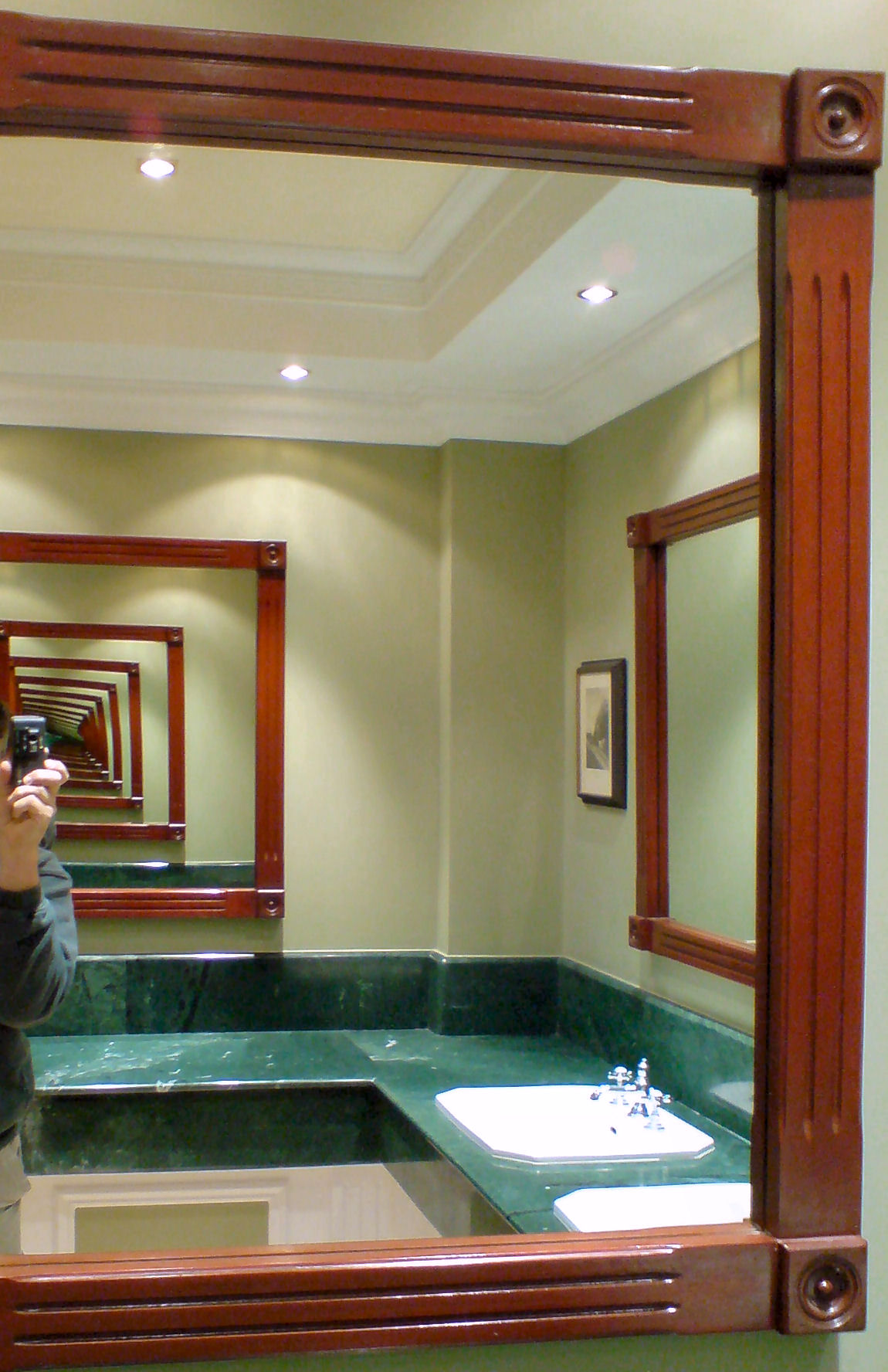
What is actually an 'infinity mirror' — and why isn't it just a light trick?
The infinity mirror (infinite mirror) is not a magical tool or a science fiction device. It is a valid physical configuration, based on the laws of light reflection known since the 11th century by Ibn al-Haytham. It consists of
at least two mirrors mounted parallel to each other — one in front, one at the back — with a light source (such as a small LED) in between. The front mirror is usually
half-silvered, meaning it allows some light to pass through while reflecting some of it. This enables our eyes to see layered reflections: light from the LED reflects off the back mirror → then the front mirror → back to the back mirror → and so on. Each reflection becomes dimmer because some light energy is lost due to absorption and scattering. Our brain interprets this decrease in brightness as increasing distance — creating the illusion of an 'endless tunnel'. Important fact:
it is not necessary to use a half-silvered mirror. With proper lighting and angles, two regular mirrors can also produce a similar effect — just less sharp.
Why does our brain believe the tunnel is 'real' — even though it's only 5 cm deep?
Human brains do not see 'absolute distance' — they build distance perception through visual cues: relative object size, blur (depth of field), brightness, and eye convergence. In an infinity mirror, each LED reflection appears smaller and dimmer than the previous one. Our visual system associates dimness with distance — like street lights that appear dimmer the farther away they are. Also, there is no scale reference (no walls, no side shadows) in the narrow space. Therefore, the brain 'completes the data' with the assumption that the reflections are truly located further and further away — even though physically, everything is within less than 10 centimeters. A neuropsychological experiment at Kyoto University (2019) showed that activation of the parietal cortex — the area responsible for spatial perception — was identical whether subjects viewed an infinity mirror or a 300-meter-long tunnel video. This proves: this illusion is not a 'mistake', but a
logical conclusion of the brain based on limited information.
Is this the same as the 'Droste effect' often associated with digital art?
Not entirely — although it may look similar. The Droste effect is a
visual recursive phenomenon: an image that contains a copy of itself, which contains another copy, and so on — like the Droste chocolate box showing a woman holding the same box. It is
static and
mathematical, often created with software or hand-drawn illustrations. An infinity mirror, however, is a
dynamic optical phenomenon: it depends on an active light source, the physical orientation of mirrors, and the interaction of light with surfaces. However, both share the same root:
the principle of repeated reflection. Artists like Yayoi Kusama have explicitly used infinity mirrors to create immersive experiences — not just images, but spaces that 'pulse' and 'breathe'. Here, technology meets psychology: repeated reflections not only expand visual space, but also weaken the boundary between self and environment — one reason many visitors report a feeling of 'loss of self' or 'transcendence' after 60–90 seconds inside the infinity mirror room.
Where else are infinity mirrors used outside of art and decoration?
The answer is: at the forefront of modern science. The James Webb Space Telescope (JWST) uses the principle of repeated reflection through
seven hexagonal mirrors arranged precisely — not for illusion, but to focus faint infrared light from the earliest galaxies. In the medical field, advanced endoscopic systems use micro-mirror arrangements to provide 360° views within body passages without additional lenses. Even in quantum labs at ETH Zurich, researchers use miniature infinity mirrors (with reflectivity >99.999%) to trap single photons for more than 15 seconds — the longest recorded light retention time in a vacuum. This helps test quantum gravity theories. So, when you see a small light repeating in a wooden box at an art gallery, you are not just seeing beauty — you are witnessing the same principle that allows us to glimpse the birth of the universe.
Can I make an infinity mirror myself — and what hidden risks are there?
Yes — and it's easy: two small mirrors (one regular, one half-silvered), some LEDs, a 3V power supply, and a dark box. But there are three critical things often overlooked. First:
the half-silvered mirror must have a reflectance:transmission ratio of 70:30 or 50:50. If too much transmission occurs, the reflections disappear; if too much reflection occurs, no light enters. Second:
the light source must be a point — not a tube or strip LED. The reflections will become blurry if the source is too large. Third:
psychological risk. A study in the Journal of Environmental Psychology (2022) found that exposure to an intense infinity mirror for more than 4 minutes can trigger mild vertigo or temporal disorientation in 12% of people — especially those with high vestibular sensitivity. It's not a physical danger, but a warning that this optical illusion directly affects the central nervous system. So, yes — you can make it. But remember: you're not just building a device, you're building
a door to an alternative perception.
---
Reference: Infinity mirror — Wikipedia
Why This Mirror Looks Like an Endless Tunnel — Even Though It's Just Two Pieces?. Have you ever seen a mirror that looks like an endless light tunnel, disappearing into an eternal darkness? It's not a digital illusion — not a CGI effect, nor a fantasy. It exists in the real world with just two reflective surfaces and one small light source. How can two ordinary mirrors trick the human brain for centuries — and why do scientists still use this principle in space telescopes today?. What is actually an 'infinity mirror' — and why isn't it just a light trick?
The infinity mirror infinite mirror is not a magical tool or a science fiction device. It is a valid physical configuration, based on the laws of light reflection known since the 11th century by Ibn al-Haytham. It consists of at least two mirrors mounted parallel to each other — one in front, one at the back — with a light source such as a small LED in between. The front mirror is usually half-silvered , meaning it allows some light to pass through while reflecting some of it. This enables our eyes to see layered reflections: light from the LED reflects off the back mirror → then the front mirror → back to the back mirror → and so on. Each reflection becomes dimmer because some light energy is lost due to absorption and scattering. Our brain interprets this decrease in brightness as increasing distance — creating the illusion of an 'endless tunnel'. Important fact: it is not necessary to use a half-silvered mirror . With proper lighting and angles, two regular mirrors can also produce a similar effect — just less sharp.
Why does our brain believe the tunnel is 'real' — even though it's only 5 cm deep?
Human brains do not see 'absolute distance' — they build distance perception through visual cues: relative object size, blur depth of field , brightness, and eye convergence. In an infinity mirror, each LED reflection appears smaller and dimmer than the previous one. Our visual system associates dimness with distance — like street lights that appear dimmer the farther away they are. Also, there is no scale reference no walls, no side shadows in the narrow space. Therefore, the brain 'completes the data' with the assumption that the reflections are truly located further and further away — even though physically, everything is within less than 10 centimeters. A neuropsychological experiment at Kyoto University 2019 showed that activation of the parietal cortex — the area responsible for spatial perception — was identical whether subjects viewed an infinity mirror or a 300-meter-long tunnel video. This proves: this illusion is not a 'mistake', but a logical conclusion of the brain based on limited information .
Is this the same as the 'Droste effect' often associated with digital art?
Not entirely — although it may look similar. The Droste effect is a visual recursive phenomenon: an image that contains a copy of itself, which contains another copy, and so on — like the Droste chocolate box showing a woman holding the same box. It is static and mathematical , often created with software or hand-drawn illustrations. An infinity mirror, however, is a dynamic optical phenomenon : it depends on an active light source, the physical orientation of mirrors, and the interaction of light with surfaces. However, both share the same root: the principle of repeated reflection . Artists like Yayoi Kusama have explicitly used infinity mirrors to create immersive experiences — not just images, but spaces that 'pulse' and 'breathe'. Here, technology meets psychology: repeated reflections not only expand visual space, but also weaken the boundary between self and environment — one reason many visitors report a feeling of 'loss of self' or 'transcendence' after 60–90 seconds inside the infinity mirror room.
Where else are infinity mirrors used outside of art and decoration?
The answer is: at the forefront of modern science. The James Webb Space Telescope JWST uses the principle of repeated reflection through seven hexagonal mirrors arranged precisely — not for illusion, but to focus faint infrared light from the earliest galaxies. In the medical field, advanced endoscopic systems use micro-mirror arrangements to provide 360° views within body passages without additional lenses. Even in quantum labs at ETH Zurich, researchers use miniature infinity mirrors with reflectivity 99.999% to trap single photons for more than 15 seconds — the longest recorded light retention time in a vacuum. This helps test quantum gravity theories. So, when you see a small light repeating in a wooden box at an art gallery, you are not just seeing beauty — you are witnessing the same principle that allows us to glimpse the birth of the universe.
Can I make an infinity mirror myself — and what hidden risks are there?
Yes — and it's easy: two small mirrors one regular, one half-silvered , some LEDs, a 3V power supply, and a dark box. But there are three critical things often overlooked. First: the half-silvered mirror must have a reflectance:transmission ratio of 70:30 or 50:50 . If too much transmission occurs, the reflections disappear; if too much reflection occurs, no light enters. Second: the light source must be a point — not a tube or strip LED . The reflections will become blurry if the source is too large. Third: psychological risk . A study in the Journal of Environmental Psychology 2022 found that exposure to an intense infinity mirror for more than 4 minutes can trigger mild vertigo or temporal disorientation in 12% of people — especially those with high vestibular sensitivity. It's not a physical danger, but a warning that this optical illusion directly affects the central nervous system. So, yes — you can make it. But remember: you're not just building a device, you're building a door to an alternative perception .
---
Reference: Infinity mirror — Wikipedia https://en.wikipedia.org/wiki/Infinity mirror