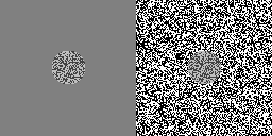
In the morning at Duke University's psychophysics lab in 1989, a young researcher placed two images on a high-speed CRT screen. One soft gray circle — like a cloud that never rained — was placed on a uniform background: a pale gray, calm, unchanging. The second circle, identical in every physical parameter, was placed on a background with randomly moving black and white dots, like static TV rain. When volunteers were asked to compare the 'contrast sharpness' of both, 93% reported: the first circle looked clearer, more 'vivid', more 'bold'. Yet — a photometric meter showed: no difference. Same number. Same light. Same color. Only perception changed — like a secret door in the brain suddenly opened without a key.
Lies in the Shadows
The Chubb illusion is not about 'weak eyes' or 'blurred vision'. It happens to everyone — neuroscientists, realist painters, ophthalmologists, and six-year-old children — without exception. It cannot be trained away, cannot be erased with glasses, and does not diminish even if you know it is playing. What you see
truly looks different — but the physical reality remains unchanged by even a thousandth of a lux. This is not a defect. This is a
built-in protocol. Like a visual operating system installed since birth: the brain does not measure contrast absolutely, but
relatively. It does not ask, 'How much light does this object reflect?' — rather, 'How does this object
compare to what surrounds it?'
When the Brain Decides to 'Fill in the Gaps'
In 2001, two scholars — Beau Lotto and Dale Purves — published a revolutionary study in
Nature Neuroscience. They did not just measure the illusion — they asked:
why did evolution allow this to exist? The answer was shocking: the Chubb illusion is the result of an ancient survival strategy. In tropical forests or dry savannas, light is rarely consistent. Tree shadows change every 30 seconds. Clouds pass by. Smoke from fires obscure the sky. Ancient human brains had no time to 'calculate' absolute luminance — they needed to make decisions
in milliseconds: 'Is that a snake in the bush?' 'Is that a prey shadow or a rock?' Therefore, the visual system evolved to
interpret context, not to measure light. The gray circle on a calm background is 'read' by the brain as 'a dominant object in a stable condition' — so its contrast is automatically enhanced. Conversely, on a high-contrast background, it is 'swallowed' as 'part of the disturbance,' and its contrast is reduced — to avoid confusing the threat detection system.
Experiments That Challenge Your Belief in Reality
Try it yourself: print two versions of the gray circle (RGB value: 128, 128, 128) — one on a clean white paper, one on a black and white polka dot paper. Hold them under the same desk lamp. No tools needed. Your eyes will rebel: the circle on the white paper looks more 'dark gray', more 'real', more 'solid'. But measure it with a spectrophotometer — their reflectance values are identical. This is not an 'illusion you can forget'. It is proof that
your visual reality is a creation of the brain, not a copy of the outside world. Every time you look, your brain is rewriting the script of reality — based on thousands of years of evolutionary experience, not raw data.
Why Artists and UI Experts Embrace This Illusion Intentionally
Renaissance artists like Caravaggio did not know the name 'Chubb illusion' — but they intuitively used its principle: dark shadows around a saint's face make the skin appear brighter, not because of additional light, but because of relative contrast. Today, user interface (UI/UX) designers at Apple and Google intentionally place important buttons on low-contrast backgrounds — not just for aesthetics, but to trigger
biological enhancement of perceived sharpness. It is not manipulation — it is a silent collaboration with the human visual system.
What This Illusion Says About 'Us'
The Chubb illusion is not about failing eyes. It is evidence that our perception is not a mirror of the world — it is the
best hypothesis built by the brain based on context, experience, and evolutionary needs. Every time you see something 'sharper' or 'fainter' than it should be, you are not being deceived — you are witnessing the wisdom hidden in your neurons. And most astonishingly: this illusion never stops working — even when you know it is happening. Because truth is not the enemy of illusion. It is a layer beneath it. A layer created not to show the world as it is — but to ensure you are still alive tomorrow morning, to recognize threats in a flash, and to see beauty in the same gray that never changes.
---
Reference: Chubb illusion — Wikipedia
Why Your Eyes Deceive You With 'False Contrast' — And This Isn't A Mistake, But An Evolutionary Design. Imagine: two identical circles — same size, same gray, same texture — but one appears sharper than the other simply because of its background. No filter, no editing. Just your brain acting as a camera that's too trusting of light. This is the Chubb illusion — not an ordinary illusion, but a window into how evolution shaped our vision over 200,000 years.. In the morning at Duke University's psychophysics lab in 1989, a young researcher placed two images on a high-speed CRT screen. One soft gray circle — like a cloud that never rained — was placed on a uniform background: a pale gray, calm, unchanging. The second circle, identical in every physical parameter , was placed on a background with randomly moving black and white dots, like static TV rain. When volunteers were asked to compare the 'contrast sharpness' of both, 93% reported: the first circle looked clearer , more 'vivid', more 'bold'. Yet — a photometric meter showed: no difference . Same number. Same light. Same color. Only perception changed — like a secret door in the brain suddenly opened without a key.
Lies in the Shadows
The Chubb illusion is not about 'weak eyes' or 'blurred vision'. It happens to everyone — neuroscientists, realist painters, ophthalmologists, and six-year-old children — without exception. It cannot be trained away, cannot be erased with glasses, and does not diminish even if you know it is playing. What you see truly looks different — but the physical reality remains unchanged by even a thousandth of a lux. This is not a defect. This is a built-in protocol . Like a visual operating system installed since birth: the brain does not measure contrast absolutely, but relatively . It does not ask, 'How much light does this object reflect?' — rather, 'How does this object compare to what surrounds it?'
When the Brain Decides to 'Fill in the Gaps'
In 2001, two scholars — Beau Lotto and Dale Purves — published a revolutionary study in Nature Neuroscience . They did not just measure the illusion — they asked: why did evolution allow this to exist? The answer was shocking: the Chubb illusion is the result of an ancient survival strategy. In tropical forests or dry savannas, light is rarely consistent. Tree shadows change every 30 seconds. Clouds pass by. Smoke from fires obscure the sky. Ancient human brains had no time to 'calculate' absolute luminance — they needed to make decisions in milliseconds : 'Is that a snake in the bush?' 'Is that a prey shadow or a rock?' Therefore, the visual system evolved to interpret context , not to measure light. The gray circle on a calm background is 'read' by the brain as 'a dominant object in a stable condition' — so its contrast is automatically enhanced. Conversely, on a high-contrast background, it is 'swallowed' as 'part of the disturbance,' and its contrast is reduced — to avoid confusing the threat detection system.
Experiments That Challenge Your Belief in Reality
Try it yourself: print two versions of the gray circle RGB value: 128, 128, 128 — one on a clean white paper, one on a black and white polka dot paper. Hold them under the same desk lamp. No tools needed. Your eyes will rebel: the circle on the white paper looks more 'dark gray', more 'real', more 'solid'. But measure it with a spectrophotometer — their reflectance values are identical. This is not an 'illusion you can forget'. It is proof that your visual reality is a creation of the brain , not a copy of the outside world. Every time you look, your brain is rewriting the script of reality — based on thousands of years of evolutionary experience, not raw data.
Why Artists and UI Experts Embrace This Illusion Intentionally
Renaissance artists like Caravaggio did not know the name 'Chubb illusion' — but they intuitively used its principle: dark shadows around a saint's face make the skin appear brighter, not because of additional light, but because of relative contrast. Today, user interface UI/UX designers at Apple and Google intentionally place important buttons on low-contrast backgrounds — not just for aesthetics, but to trigger biological enhancement of perceived sharpness . It is not manipulation — it is a silent collaboration with the human visual system.
What This Illusion Says About 'Us'
The Chubb illusion is not about failing eyes. It is evidence that our perception is not a mirror of the world — it is the best hypothesis built by the brain based on context, experience, and evolutionary needs. Every time you see something 'sharper' or 'fainter' than it should be, you are not being deceived — you are witnessing the wisdom hidden in your neurons. And most astonishingly: this illusion never stops working — even when you know it is happening. Because truth is not the enemy of illusion. It is a layer beneath it. A layer created not to show the world as it is — but to ensure you are still alive tomorrow morning, to recognize threats in a flash, and to see beauty in the same gray that never changes.
---
Reference: Chubb illusion — Wikipedia https://en.wikipedia.org/wiki/Chubb illusion