Baghdad, 825 AD: When Algebra Was Born Under the Tigris Breeze
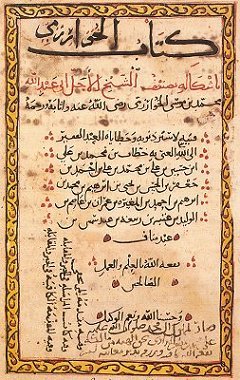
It was an unremarkable morning—dry winds blew from the desert, dust danced around the newly built Dar al-Hikmah library in the heart of Baghdad. Inside a small room with blue tiled floors, a man in a grey robe sat hunched over a mat, a quill pen in his hand moving swiftly across goat skin. His name was Muhammad ibn Musa al-Khwārizmī. He was not just a scribe; he was the architect of a new way of thinking. The book he was writing—
Al-Kitāb al-mukhtaṣar fī ḥisāb al-jabr wa-l-muqābala—was not merely a mathematical text. It was a hidden revolution: for the first time in human history, ‘al-jabr’ (restoration) was established as a distinct discipline—not a branch of arithmetic, not an extension of Greek geometry, but the science of
managing unknowns: equations without definite answers, variables without fixed values, symbols representing abstract realities. The word ‘algebra’ today originates from its title—and the word ‘algorithm’ from his name.
From India to Baghdad: The Zero That Shook the World
Al-Khwārizmī did not work in a vacuum. He translated and synthesized two great traditions: Euclid's geometry and Archimedes' mechanics from Alexandria, as well as Aryabhata's and Brahmagupta's arithmetic from Nalanda and Ujjain. But the most radical element was not a formula—but
a single symbol: zero (ṣifr). In India, zero was a metaphysical concept—an empty cluster, the starting point of cycles of time. In the hands of Islamic scholars, it became a practical tool for calculation. Al-Khwārizmī extended the Indian place-value system to decimal fractions: 3.1416 was no longer a rough approximation from Archimedes, but a number that could be added, subtracted, multiplied, and raised to powers with unexpected precision. In his treatise
Kitāb al-Jamʿ wa-l-tafrīq bi-ḥisāb al-Hind, he demonstrated how to multiply 987 × 654 using only ten digits—including zero—without an abacus, without geometry, just positional logic. This idea was so alien to the Roman world, which still used Roman numerals until the 13th century: CXLII + XVII = CLIX—but
there was no systematic way to multiply or divide. Zero was not just a number. It was the gateway to the world of mathematical abstraction.
Bukhara & Cordova: Seeds of Knowledge Spreading Like Light
After Baghdad, the flame of knowledge did not extinguish—it moved. In Bukhara, Al-Karaji (10th century) severed the last ties between algebra and geometry. In
Al-Fakhri, he proved identities like (a + b)³ using pure algebra—without diagrams of squares or wooden cubes. He introduced early mathematical induction, proving formulas for sums of powers step by step—long before Pascal or Fermat. Simultaneously, in the southwest of Andalusia, in the glorious Cordova under Caliph Abd al-Rahman III, Ibn al-Haytham (Alhazen) combined spherical trigonometry with experimental optics, creating early integration methods to calculate the area of parabolic segments—more than 600 years before Newton wrote his
Principia.
Mosques, Observatories & Markets: Mathematics Alive in Every Corner
Medieval Islamic mathematics was not an ivory tower science. It was born from real needs: determining the Qibla direction for the five daily prayers—requiring precise spherical trigonometry; calculating Zakat and inheritance—requiring complex systems of linear equations; measuring land after the Nile floods—requiring practical geometry; and organizing the Hijri calendar—requiring high-precision astronomy. At the Maragheh observatory (Iran), Nasir al-Din al-Tusi developed modern trigonometric functions, separating trigonometry from astronomy and making it an independent branch—complete with sine tables to six decimal places. In the markets of Basra, merchants used ‘hisāb al-khaṭā’ (line calculation)—a visual method of algebra that replaced letters with straight and curved lines to solve commercial problems.
An Invisible Legacy: From Toledo to Cambridge
The 12th century marked a silent yet decisive turning point. In Toledo, newly conquered by Christians, a translation center led by Gerard of Cremona translated over 70 Arabic manuscripts into Latin—including al-Khwārizmī's
Algebra, al-Tusi's
Almagest, and Jabir ibn Aflah's trigonometry treatise. Robert of Chester translated the
Algebra in 1145—and in his introduction, he wrote:
‘I do not translate this for mere academic interest, but because no other book in the world can explain how to calculate inheritances, land shares, or interest rates with certainty.’ Five centuries later, when Descartes wrote
La Géométrie, he did not start from scratch—he began from symbolic algebra that was already mature in the hands of al-Karaji and al-Samaw’al. Even Leibniz's calculus uses the notation ‘∫’ inspired by the letter ‘S’ in ‘summa’—but the concept of infinite summation itself had been explored by Ibn al-Haytham in his analysis of parabolas in the 10th century.
Medieval Islamic mathematics was not a ‘link’ between Greece and Europe—it was a new operating system built from the ground up. It did not just preserve old knowledge; it developed a new language for thinking about space, time, and relationships. And every time we press ‘=’ on a calculator, write ‘x² + 5x − 6 = 0’, or see a function graph on a screen—we are not just using a tool. We are re-uttering a legacy born from boundless curiosity, selfless perseverance, and the conviction that human reason, guided by revelation and observation, is capable of mapping the hidden structures of the universe.
---
Reference: Mathematics in the medieval Islamic world — Wikipedia
Why Europe Never Calculated Without These 7 Islamic Figures?. While Europe debated the existence of the number zero, scholars in Baghdad, Bukhara, and Cordova developed algebra, modern trigonometry, and the decimal system—all within a single century. Who were they? And why were their works copied, translated, and then hidden for centuries? The answers are not just in old manuscripts... but in every calculator today.. Baghdad, 825 AD: When Algebra Was Born Under the Tigris Breeze
It was an unremarkable morning—dry winds blew from the desert, dust danced around the newly built Dar al-Hikmah library in the heart of Baghdad. Inside a small room with blue tiled floors, a man in a grey robe sat hunched over a mat, a quill pen in his hand moving swiftly across goat skin. His name was Muhammad ibn Musa al-Khwārizmī. He was not just a scribe; he was the architect of a new way of thinking. The book he was writing— Al-Kitāb al-mukhtaṣar fī ḥisāb al-jabr wa-l-muqābala —was not merely a mathematical text. It was a hidden revolution: for the first time in human history, ‘al-jabr’ restoration was established as a distinct discipline—not a branch of arithmetic, not an extension of Greek geometry, but the science of managing unknowns : equations without definite answers, variables without fixed values, symbols representing abstract realities. The word ‘algebra’ today originates from its title—and the word ‘algorithm’ from his name.
From India to Baghdad: The Zero That Shook the World
Al-Khwārizmī did not work in a vacuum. He translated and synthesized two great traditions: Euclid's geometry and Archimedes' mechanics from Alexandria, as well as Aryabhata's and Brahmagupta's arithmetic from Nalanda and Ujjain. But the most radical element was not a formula—but a single symbol : zero ṣifr . In India, zero was a metaphysical concept—an empty cluster, the starting point of cycles of time. In the hands of Islamic scholars, it became a practical tool for calculation. Al-Khwārizmī extended the Indian place-value system to decimal fractions: 3.1416 was no longer a rough approximation from Archimedes, but a number that could be added, subtracted, multiplied, and raised to powers with unexpected precision. In his treatise Kitāb al-Jamʿ wa-l-tafrīq bi-ḥisāb al-Hind , he demonstrated how to multiply 987 × 654 using only ten digits—including zero—without an abacus, without geometry, just positional logic. This idea was so alien to the Roman world, which still used Roman numerals until the 13th century: CXLII + XVII = CLIX—but there was no systematic way to multiply or divide . Zero was not just a number. It was the gateway to the world of mathematical abstraction.
Bukhara & Cordova: Seeds of Knowledge Spreading Like Light
After Baghdad, the flame of knowledge did not extinguish—it moved. In Bukhara, Al-Karaji 10th century severed the last ties between algebra and geometry. In Al-Fakhri , he proved identities like a + b ³ using pure algebra—without diagrams of squares or wooden cubes. He introduced early mathematical induction, proving formulas for sums of powers step by step—long before Pascal or Fermat. Simultaneously, in the southwest of Andalusia, in the glorious Cordova under Caliph Abd al-Rahman III, Ibn al-Haytham Alhazen combined spherical trigonometry with experimental optics, creating early integration methods to calculate the area of parabolic segments—more than 600 years before Newton wrote his Principia .
Mosques, Observatories & Markets: Mathematics Alive in Every Corner
Medieval Islamic mathematics was not an ivory tower science. It was born from real needs: determining the Qibla direction for the five daily prayers—requiring precise spherical trigonometry; calculating Zakat and inheritance—requiring complex systems of linear equations; measuring land after the Nile floods—requiring practical geometry; and organizing the Hijri calendar—requiring high-precision astronomy. At the Maragheh observatory Iran , Nasir al-Din al-Tusi developed modern trigonometric functions, separating trigonometry from astronomy and making it an independent branch—complete with sine tables to six decimal places. In the markets of Basra, merchants used ‘hisāb al-khaṭā’ line calculation —a visual method of algebra that replaced letters with straight and curved lines to solve commercial problems.
An Invisible Legacy: From Toledo to Cambridge
The 12th century marked a silent yet decisive turning point. In Toledo, newly conquered by Christians, a translation center led by Gerard of Cremona translated over 70 Arabic manuscripts into Latin—including al-Khwārizmī's Algebra , al-Tusi's Almagest , and Jabir ibn Aflah's trigonometry treatise. Robert of Chester translated the Algebra in 1145—and in his introduction, he wrote: ‘I do not translate this for mere academic interest, but because no other book in the world can explain how to calculate inheritances, land shares, or interest rates with certainty.’ Five centuries later, when Descartes wrote La Géométrie , he did not start from scratch—he began from symbolic algebra that was already mature in the hands of al-Karaji and al-Samaw’al. Even Leibniz's calculus uses the notation ‘∫’ inspired by the letter ‘S’ in ‘summa’—but the concept of infinite summation itself had been explored by Ibn al-Haytham in his analysis of parabolas in the 10th century.
Medieval Islamic mathematics was not a ‘link’ between Greece and Europe—it was a new operating system built from the ground up. It did not just preserve old knowledge; it developed a new language for thinking about space, time, and relationships. And every time we press ‘=’ on a calculator, write ‘x² + 5x − 6 = 0’, or see a function graph on a screen—we are not just using a tool. We are re-uttering a legacy born from boundless curiosity, selfless perseverance, and the conviction that human reason, guided by revelation and observation, is capable of mapping the hidden structures of the universe.
---
Reference: Mathematics in the medieval Islamic world — Wikipedia https://en.wikipedia.org/wiki/Mathematics in the medieval Islamic world