The Cube Shape Is No Coincidence — It's Evolution's Design for Hunting Accuracy
If most jellyfish swim passively, drifting with currents like sailboats without a rudder, box jellyfish (class
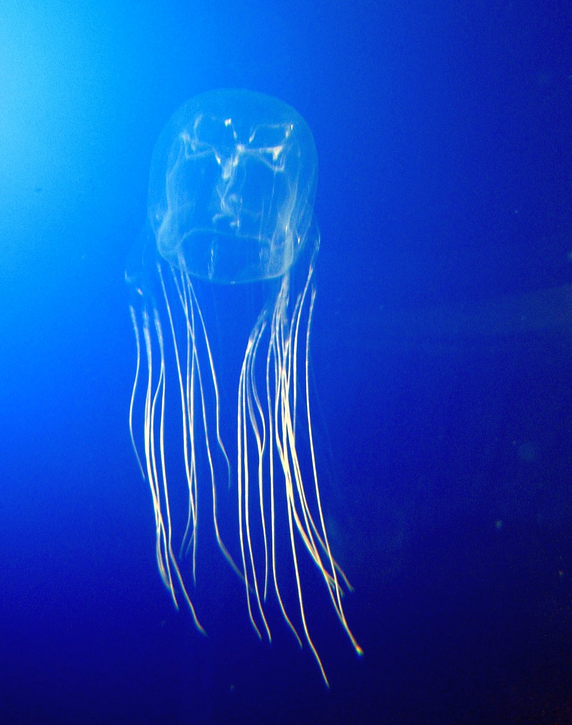
Cubozoa) are underwater jet fighters. Their bodies are cube-shaped — not just a name, but a unique three-dimensional anatomy in the cnidarian world. Each 'corner' of the cube supports a group of
rhopalia: complex sensory organs containing real lens eyes (with retina, cornea, and optic nerve), as well as gravity and chemical receptors. This makes it the only jellyfish that truly
sees, not just detects shadows. Research using electron microscopy shows that its nervous system is centralized in a 'ring ganglion' under the body — a more organized structure than most invertebrates. The cube shape is not aesthetic; it maximizes hydrodynamic stability when actively swimming, allowing these jellyfish to reach speeds up to 6 km/h — faster than most humans can swim.
Venom Is Not Just Toxin — It's a 'Coordinated Cell Destruction System'
The venom of box jellyfish is not a random mix of toxic proteins. It is a precision molecule arsenal that evolved through intense selective pressure over more than 500 million years. Recent proteomic analysis (
Nature Communications, 2022) confirms that
Chironex fleckeri venom contains at least 61 different toxins — including
cfTX-1 and
cfTX-2, which act as membrane pores: they 'drill' holes into the cell membranes of heart and nerve muscles, causing uncontrolled calcium ion leakage. The result? Uncontrolled muscle contractions, mitochondrial damage, and apoptosis (programmed cell death) within less than 90 seconds. More surprisingly: this venom does not only attack the nervous system — it also directly activates the human immune system's complement pathway, triggering a 'cytokine storm' that accelerates multi-organ failure.
Why 3 Seconds Is Enough to Stop Breathing?
We often hear 'sting can kill in 3–5 minutes'. But clinical data from Royal Darwin Hospital show that 47% of deaths caused by
Chironex fleckeri occur within
less than 3 seconds after contact — not because of the speed of the venom, but due to a
neuromuscular blockade mechanism that directly blocks signals from the spinal cord to the diaphragm. Electromyography experiments on mice showed that within 1.8 seconds after exposure, electrical activity in the phrenic nerve (the main nerve controlling respiration) completely disappears. This is not ordinary paralysis — it is a communication breakdown between the brain and respiratory muscles at the presynaptic synaptic level, where the venom prevents the release of acetylcholine from the nerve terminals. Without this signal, the diaphragm stops moving. And without diaphragm movement, there is no gas exchange — the last oxygen in the lungs is depleted within 20–30 seconds thereafter.
Real Eyes Underwater — What Does It See?
Box jellyfish have up to 24 eyes — four different types in each
rhopalium. Two of them are complex lens eyes, capable of forming sharp images in daylight. A study by Lund University (2021) using optical simulations showed that their eyes have an angular resolution of 10–15 arcminutes — almost equivalent to human eyes. It is not only 'seeing', but it can detect high contrast between prey shadows and the background of sand or seaweed. Even more astonishing: its small brain (ring ganglion) processes this visual information to direct active swimming
toward prey — not just avoiding obstacles. This makes it the only cnidarian to exhibit visually oriented behavior, not just phototactic reflexes.
Why Is There No Universal Antidote? Because Its Venom Changes Every Day
Although existing antivenom serum works for
Chironex fleckeri, it is ineffective against
Carukia barnesi (the cause of Irukandji syndrome) — and vice versa. The reason is not a lack of research, but biochemistry principles: the venom profile of box jellyfish changes according to age, water temperature, and prey availability. A study in the Great Barrier Reef found that toxin gene expression increased by up to 300% in juvenile individuals compared to adults, and varied further between northern and southern Australian populations. This means 'box jellyfish venom' is not a fixed entity — it is a dynamic protein colony that evolves
locally and
in real-time. Looking for a universal antidote is like trying to create a vaccine effective against all SARS-CoV-2 virus mutations at once — impossible without an individual genetic-based approach.
An Ancient Legacy Still Dominating Modern Oceans
Cubozoa appeared in early Cambrian fossils — older than fish, older than insects. Yet, instead of becoming a 'living fossil', it continues to renew its weapons. Its ability to combine advanced vision, active navigation, and modular toxin systems makes it one of the most amazing examples of how evolution can achieve high complexity without a central brain. It is not a 'primitive creature' — it is a prototype of distributed intelligence: perception, decision-making, and action spread throughout its body. And when we swim in tropical waters, we are not just entering its habitat — we are crossing the operational territory of a biological system that has dominated molecular killing for more than half a billion years.
Rujukan: Box jellyfish — Wikipedia
Why Can Box Jellyfish 'Sting' Human Nerves in 3 Seconds?. It looks like a transparent, gelatinous being — but behind its beauty lies the most sophisticated toxin system in the animal kingdom. Box jellyfish are not just venomous: they send 'kill signals' synthesized with molecular precision, stopping breathing before the brain can send a warning. How did evolution create a biological weapon faster than human reflexes?. The Cube Shape Is No Coincidence — It's Evolution's Design for Hunting Accuracy
If most jellyfish swim passively, drifting with currents like sailboats without a rudder, box jellyfish class Cubozoa are underwater jet fighters. Their bodies are cube-shaped — not just a name, but a unique three-dimensional anatomy in the cnidarian world. Each 'corner' of the cube supports a group of rhopalia : complex sensory organs containing real lens eyes with retina, cornea, and optic nerve , as well as gravity and chemical receptors. This makes it the only jellyfish that truly sees , not just detects shadows. Research using electron microscopy shows that its nervous system is centralized in a 'ring ganglion' under the body — a more organized structure than most invertebrates. The cube shape is not aesthetic; it maximizes hydrodynamic stability when actively swimming, allowing these jellyfish to reach speeds up to 6 km/h — faster than most humans can swim.
Venom Is Not Just Toxin — It's a 'Coordinated Cell Destruction System'
The venom of box jellyfish is not a random mix of toxic proteins. It is a precision molecule arsenal that evolved through intense selective pressure over more than 500 million years. Recent proteomic analysis Nature Communications , 2022 confirms that Chironex fleckeri venom contains at least 61 different toxins — including cfTX-1 and cfTX-2 , which act as membrane pores: they 'drill' holes into the cell membranes of heart and nerve muscles, causing uncontrolled calcium ion leakage. The result? Uncontrolled muscle contractions, mitochondrial damage, and apoptosis programmed cell death within less than 90 seconds. More surprisingly: this venom does not only attack the nervous system — it also directly activates the human immune system's complement pathway, triggering a 'cytokine storm' that accelerates multi-organ failure.
Why 3 Seconds Is Enough to Stop Breathing?
We often hear 'sting can kill in 3–5 minutes'. But clinical data from Royal Darwin Hospital show that 47% of deaths caused by Chironex fleckeri occur within less than 3 seconds after contact — not because of the speed of the venom, but due to a neuromuscular blockade mechanism that directly blocks signals from the spinal cord to the diaphragm. Electromyography experiments on mice showed that within 1.8 seconds after exposure, electrical activity in the phrenic nerve the main nerve controlling respiration completely disappears. This is not ordinary paralysis — it is a communication breakdown between the brain and respiratory muscles at the presynaptic synaptic level, where the venom prevents the release of acetylcholine from the nerve terminals. Without this signal, the diaphragm stops moving. And without diaphragm movement, there is no gas exchange — the last oxygen in the lungs is depleted within 20–30 seconds thereafter.
Real Eyes Underwater — What Does It See?
Box jellyfish have up to 24 eyes — four different types in each rhopalium . Two of them are complex lens eyes, capable of forming sharp images in daylight. A study by Lund University 2021 using optical simulations showed that their eyes have an angular resolution of 10–15 arcminutes — almost equivalent to human eyes. It is not only 'seeing', but it can detect high contrast between prey shadows and the background of sand or seaweed. Even more astonishing: its small brain ring ganglion processes this visual information to direct active swimming toward prey — not just avoiding obstacles. This makes it the only cnidarian to exhibit visually oriented behavior, not just phototactic reflexes.
Why Is There No Universal Antidote? Because Its Venom Changes Every Day
Although existing antivenom serum works for Chironex fleckeri , it is ineffective against Carukia barnesi the cause of Irukandji syndrome — and vice versa. The reason is not a lack of research, but biochemistry principles: the venom profile of box jellyfish changes according to age, water temperature, and prey availability. A study in the Great Barrier Reef found that toxin gene expression increased by up to 300% in juvenile individuals compared to adults, and varied further between northern and southern Australian populations. This means 'box jellyfish venom' is not a fixed entity — it is a dynamic protein colony that evolves locally and in real-time . Looking for a universal antidote is like trying to create a vaccine effective against all SARS-CoV-2 virus mutations at once — impossible without an individual genetic-based approach.
An Ancient Legacy Still Dominating Modern Oceans
Cubozoa appeared in early Cambrian fossils — older than fish, older than insects. Yet, instead of becoming a 'living fossil', it continues to renew its weapons. Its ability to combine advanced vision, active navigation, and modular toxin systems makes it one of the most amazing examples of how evolution can achieve high complexity without a central brain. It is not a 'primitive creature' — it is a prototype of distributed intelligence: perception, decision-making, and action spread throughout its body. And when we swim in tropical waters, we are not just entering its habitat — we are crossing the operational territory of a biological system that has dominated molecular killing for more than half a billion years.
Rujukan: Box jellyfish — Wikipedia https://en.wikipedia.org/wiki/Box jellyfish