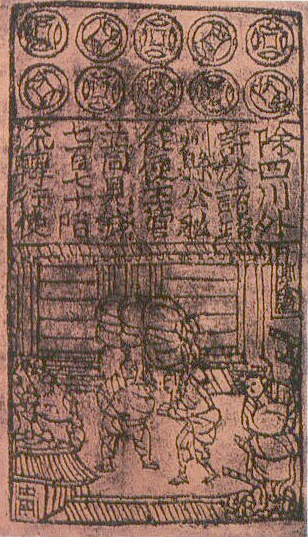
1. The World's First Paper Money Wasn't Created by a Central Bank — But by a Chinese Governor Who Feared Running Out of Copper
In 1024 AD, in the Sichuan region, under the Southern Song Dynasty, an official named Zhang Yong faced an unavoidable crisis: his people used thousands of kilograms of copper and iron as coinage — making it heavier than 10 kg for regular transactions. Copper mines were sluggish, fraud was rising, and transporting money became a real danger for merchants. So, Zhang Yong introduced
jiaozi: a sealed official paper note, handwritten in classical script, and issued under strict control by local authorities. It wasn't a promise of payment — it
was payment. And this was the first officially recognized paper money in the world, fully accepted as a medium of exchange by the state. No central bank, no gold reserve system — just trust, administrative accountability, and severe punishment for counterfeiting (including the death penalty since 1039).
2. In Japan & Egypt, Paper Money Emerged Not Because of Progress — But Because of Currency Crises
Japan followed China in the 17th century with
yamada-kin, paper notes issued by a samurai family managing gold mines in Kyoto. Surprisingly: it wasn't a main economic tool — it was a
temporary loan guarantee. When gold shortages worsened, the family printed paper as 'receipts' that could be redeemed — and accidentally created a paper-based currency system that lasted 200 years. In Egypt, in the 10th century, Fatimid traders in Cairo used payable letters (
sakk) that could be transferred — this document wasn't technically paper money, but it became the basis of modern Islamic banking law and influenced the evolution of
cheques in Europe. Key fact: paper money wasn't solely the result of technological progress — it was born from economic pressure, metal scarcity, and the urgent need for flexibility.
3. A Single Malaysian Ringgit Today Contains 17 Security Layers — More Than a USD 100 from 1996
Paper money is no longer just paper and ink. For example, the RM100 2022 edition combines an
optical variable device (OVD) that changes color when tilted, a fluorescent security thread with microcodes visible only under 100x magnification, micro diamond ink that forms a subtle pattern under normal light, and a three-dimensional watermark with unique tonal depth. Overall, it has 17 physical and optical security features — compare this to the 1996 'Biggie' USD100, which only had 5 features (and is still in use today). This improvement isn't for luxury: each feature is designed to prevent counterfeiting, now using 600 dpi inkjet printers, AI image generation software, and nano-cloning techniques. Interestingly, Bank Negara Malaysia reported that the success rate of counterfeit bills dropped by 83% after the launch of the New Series 2012 — not because people are smarter, but because the paper is now smarter than most counterfeiters.
4. Paper Money Is a Moving Historical Document — Every Design Tells a Story of Changing Power
Look at the Malaysian 1967 series: the image of Sultan Abu Bakar Johor on the left, the emblem of the Federation of Malaya in the center, and dominant Jawi script. Now, the 2024 RM50 series features the national scientist Dr. Zakri Abdul Hamid on the left, an illustration of the MEASAT satellite behind, and a QR code linking to the Bank Negara digital archive. These changes are not aesthetic — they are a hidden political map. In Zimbabwe, the $100 trillion note issued in 2009 was not a symbol of wealth, but an acknowledgment that the currency had lost all meaning. In post-World War I Germany, Reichsmark notes were printed on recycled newspaper paper due to material shortages — and the value of 1 mark fell from 0.64 USD to
less than 0.00000000001 USD within 12 years. Paper money is not just a medium of exchange — it is a reflective mirror of power, social belief, and institutional stability.
5. Paper Money Will Live Longer Than You — Even Though the World Moves to Digital
Many predict the death of paper money by 2030. However, data from the Bank for International Settlements (BIS) in 2023 shows: global cash usage has
increased by 6.2% since 2020 — not decreased. In Sweden, the most 'cashless' country, 8% of transactions are still cash. In India, after the 2016 demonetization, the amount of circulating paper money increased by 37% over five years. Why? Because paper money is the only form of currency that doesn't require an internet connection, digital identity, or platform permission. It is an inalienable economic right: anonymity, resilience, and autonomy. Most importantly — it is the only financial instrument that cannot be 'frozen' by algorithms or 'deleted' by central servers. So yes, e-wallets will grow. But paper money? It won't disappear — it will evolve into something smarter, safer, and more meaningful than ever before.
---
Reference: Paper money — Wikipedia
The World's First Paper Money Was Printed in the 7th Century — But Not in Europe. Many assume paper money emerged with the Industrial Revolution or the Bank of England. Wrong. It appeared 600 years earlier — in a kingdom that had never seen a printing press. How did it function without a modern banking system? Why did it nearly vanish twice in history? And why does a single bill today contain more technology than a 2005 smartphone?. 1. The World's First Paper Money Wasn't Created by a Central Bank — But by a Chinese Governor Who Feared Running Out of Copper
In 1024 AD, in the Sichuan region, under the Southern Song Dynasty, an official named Zhang Yong faced an unavoidable crisis: his people used thousands of kilograms of copper and iron as coinage — making it heavier than 10 kg for regular transactions. Copper mines were sluggish, fraud was rising, and transporting money became a real danger for merchants. So, Zhang Yong introduced jiaozi : a sealed official paper note, handwritten in classical script, and issued under strict control by local authorities. It wasn't a promise of payment — it was payment. And this was the first officially recognized paper money in the world, fully accepted as a medium of exchange by the state. No central bank, no gold reserve system — just trust, administrative accountability, and severe punishment for counterfeiting including the death penalty since 1039 .
2. In Japan & Egypt, Paper Money Emerged Not Because of Progress — But Because of Currency Crises
Japan followed China in the 17th century with yamada-kin , paper notes issued by a samurai family managing gold mines in Kyoto. Surprisingly: it wasn't a main economic tool — it was a temporary loan guarantee . When gold shortages worsened, the family printed paper as 'receipts' that could be redeemed — and accidentally created a paper-based currency system that lasted 200 years. In Egypt, in the 10th century, Fatimid traders in Cairo used payable letters sakk that could be transferred — this document wasn't technically paper money, but it became the basis of modern Islamic banking law and influenced the evolution of cheques in Europe. Key fact: paper money wasn't solely the result of technological progress — it was born from economic pressure, metal scarcity, and the urgent need for flexibility.
3. A Single Malaysian Ringgit Today Contains 17 Security Layers — More Than a USD 100 from 1996
Paper money is no longer just paper and ink. For example, the RM100 2022 edition combines an optical variable device OVD that changes color when tilted, a fluorescent security thread with microcodes visible only under 100x magnification, micro diamond ink that forms a subtle pattern under normal light, and a three-dimensional watermark with unique tonal depth. Overall, it has 17 physical and optical security features — compare this to the 1996 'Biggie' USD100, which only had 5 features and is still in use today . This improvement isn't for luxury: each feature is designed to prevent counterfeiting, now using 600 dpi inkjet printers, AI image generation software, and nano-cloning techniques. Interestingly, Bank Negara Malaysia reported that the success rate of counterfeit bills dropped by 83% after the launch of the New Series 2012 — not because people are smarter, but because the paper is now smarter than most counterfeiters.
4. Paper Money Is a Moving Historical Document — Every Design Tells a Story of Changing Power
Look at the Malaysian 1967 series: the image of Sultan Abu Bakar Johor on the left, the emblem of the Federation of Malaya in the center, and dominant Jawi script. Now, the 2024 RM50 series features the national scientist Dr. Zakri Abdul Hamid on the left, an illustration of the MEASAT satellite behind, and a QR code linking to the Bank Negara digital archive. These changes are not aesthetic — they are a hidden political map. In Zimbabwe, the $100 trillion note issued in 2009 was not a symbol of wealth, but an acknowledgment that the currency had lost all meaning. In post-World War I Germany, Reichsmark notes were printed on recycled newspaper paper due to material shortages — and the value of 1 mark fell from 0.64 USD to less than 0.00000000001 USD within 12 years. Paper money is not just a medium of exchange — it is a reflective mirror of power, social belief, and institutional stability.
5. Paper Money Will Live Longer Than You — Even Though the World Moves to Digital
Many predict the death of paper money by 2030. However, data from the Bank for International Settlements BIS in 2023 shows: global cash usage has increased by 6.2% since 2020 — not decreased. In Sweden, the most 'cashless' country, 8% of transactions are still cash. In India, after the 2016 demonetization, the amount of circulating paper money increased by 37% over five years. Why? Because paper money is the only form of currency that doesn't require an internet connection, digital identity, or platform permission. It is an inalienable economic right: anonymity, resilience, and autonomy. Most importantly — it is the only financial instrument that cannot be 'frozen' by algorithms or 'deleted' by central servers. So yes, e-wallets will grow. But paper money? It won't disappear — it will evolve into something smarter, safer, and more meaningful than ever before.
---
Reference: Paper money — Wikipedia https://en.wikipedia.org/wiki/Paper money