What Happens If Gas Doesn't Dare to Become a Star?
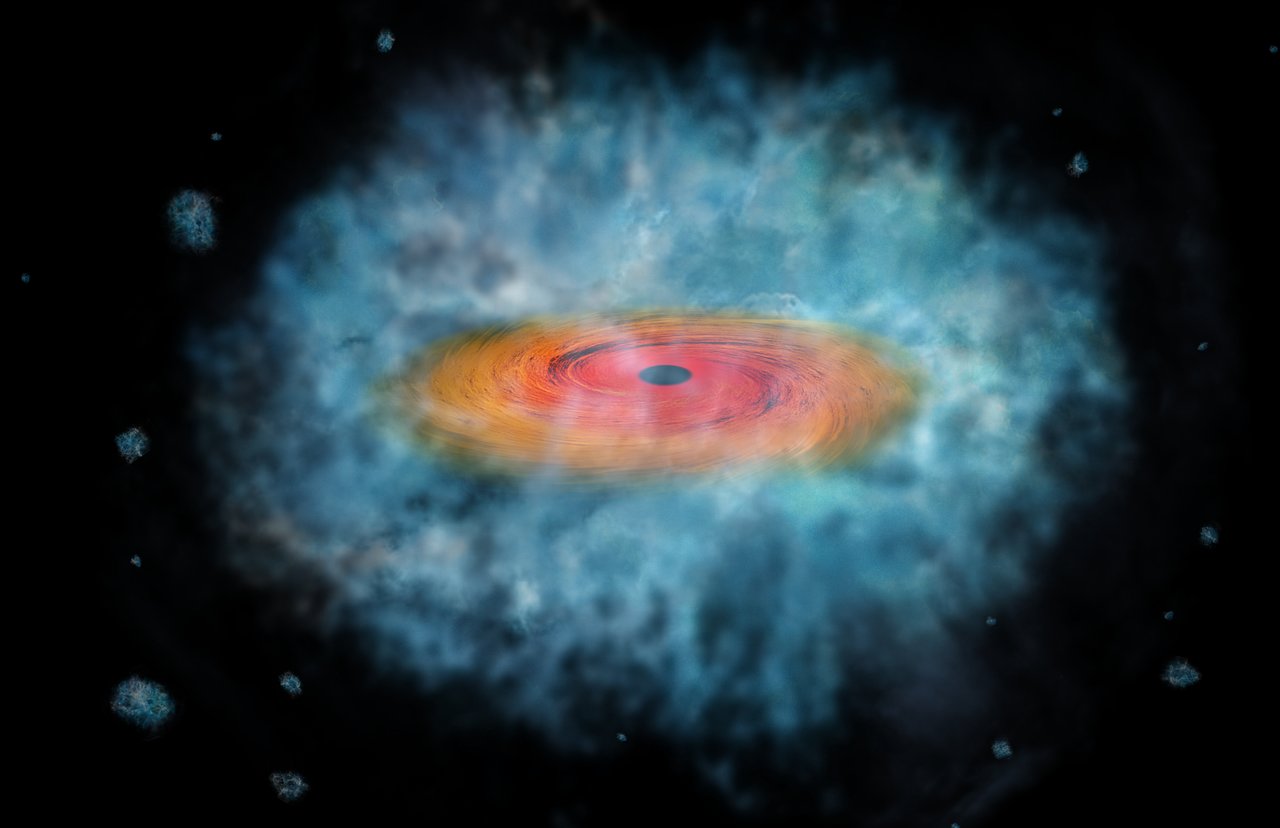
Imagine: the universe is only 150 million years old. There are no galaxies as we know them today. No metals, no cosmic dust, no light from second or third-generation stars. Here, amidst the eternal darkness and the lingering warmth of the Big Bang, a giant cloud of hydrogen and helium — millions of times larger than the Sun — began to spin slowly. But something prevented it from breaking into thousands of small stars. There was no efficient cooling. No cooling molecules like H₂ or CO. No gravitational 'stirring' from neighboring stars. So, instead of stars being born, the cloud
continued to collapse — relentlessly, without brakes — into a single infinitely dense point. This was not stellar death. This was the
birth of a black hole without any stellar birth at all.
Why the 'Population III Star' Model Fails to Explain z=7 Black Holes?
Observations from the James Webb Space Telescope (JWST) since 2023 have shaken cosmology: in galaxies like UHZ1 and CEERS-J1419, supermassive black holes — with masses of 1–10 billion M☉ — were already active at redshift z ≈ 7–8. This means they existed when the universe was less than 800 million years old. If they started as seeds from Population III stars (the first stars, with masses of 100–300 M☉), they would need to grow at a
continuous maximum accretion rate for hundreds of millions of years — something physically almost impossible without interruption, without starvation phases, without gravitational disturbances from surrounding stars or gas. Computer simulations show that stellar seeds could only reach ~1,000 M☉ within 200 million years — far from the 10⁵ M☉ needed to initiate the leap to supermassive within the limited timeframe.
What is 'Direct Relativistic Instability' — And Why Isn't It Just Another Theory?
Direct collapse black holes (DCBH) are not just large black holes. They are the product of
general, unavoidable gravitational instability in hot (>10,000 K), metal-free gas clouds exposed to strong ultralow-frequency radiation from neighboring stars. This radiation does not aid star formation — instead, it
dissolves hydrogen molecules, hindering gas cooling, and causing the cloud to be unable to fragment. Consequently, the entire cloud — often 10⁴–10⁶ M☉ — collapses homogeneously, without the formation of stellar cores. In full relativistic simulations by the Volonteri (2022) and Latif (2023) groups, this process produces black hole seeds between 30,000 and 150,000 M☉ — precisely in the range needed to explain z > 6 observations. This is not speculation: it is the only scenario consistent with the Eddington accretion limit, cosmic time constraints, and the far-infrared emission spectrum of early galaxies.
Infinity Galaxy: The First Undeniable Proof?
In January 2025, Pieter van Dokkum's team of astronomers from Yale University announced the discovery of object XJ1422+1137 in the Infinity galaxy (also known as JADES-GS-z14-0) — the most distant galaxy known at z = 14.32 (universe age ~290 million years). Combined data from JWST/NIRSpec and the Chandra X-ray Observatory showed: (1) no optical light from young stars; (2) very strong yet narrow X-ray emission, with no signs of accretion winds or jets; (3) the spectrum showed He II and C IV emission lines without O III or N II — strong indicators of no metals around the center; and (4) the seed mass was estimated at 8.4 × 10⁴ M☉ through gas dynamical modeling. No collapsing star or star cluster model could explain all these characteristics simultaneously. Van Dokkum concluded: “This is not an ordinary black hole. It is a DCBH seed — and possibly the first one seen directly.”
Why Does This Discovery Change the Cosmological Map?
DCBHs are not just a 'new type of black hole'. They are evidence that gravity, in the extreme conditions of the early universe, could act
autonomously — without stellar intermediaries, without stellar evolution, without complex chemistry. They prove that massive structures could emerge in the 'dark ages' before the era of full reionization. More profoundly: if DCBHs existed widely, then the centers of early galaxies were not populated by small, slowly growing seeds — but by 'giant seeds' that immediately controlled the evolution of their surrounding galaxies through radiation and accretion outflows. This explains why early galaxies like GN-z11 had active nuclei so early — not because they grew fast, but because they were
born large. And if DCBH seeds were widespread, then the number of ancient black holes in the universe might be much higher than previously estimated — opening the possibility that many of today's non-luminous 'dark galaxies' are actually powered by dormant DCBHs.
The discovery of the Infinity Galaxy is not the end of research — it is the beginning. Astronomers are now developing future radio missions like the SKA and the LISA gravitational wave telescope to track gravitational waves from early DCBH mergers. Because one thing is certain: the universe did not wait for stars to be born to begin the black hole era. It started it before the first star ignited.
How a Black Hole 100,000 Times the Sun's Mass Formed — Without a Star?. In the depths of the early universe — when stars were just taking their first breaths — a giant black hole emerged *without going through stellar death*. It wasn't the result of a supernova explosion. Nor was it the remnant of a neutron star. It collapsed directly from primordial gas clouds. And in 2025, concrete evidence was finally found.. What Happens If Gas Doesn't Dare to Become a Star?
Imagine: the universe is only 150 million years old. There are no galaxies as we know them today. No metals, no cosmic dust, no light from second or third-generation stars. Here, amidst the eternal darkness and the lingering warmth of the Big Bang, a giant cloud of hydrogen and helium — millions of times larger than the Sun — began to spin slowly. But something prevented it from breaking into thousands of small stars. There was no efficient cooling. No cooling molecules like H₂ or CO. No gravitational 'stirring' from neighboring stars. So, instead of stars being born, the cloud continued to collapse — relentlessly, without brakes — into a single infinitely dense point. This was not stellar death. This was the birth of a black hole without any stellar birth at all .
Why the 'Population III Star' Model Fails to Explain z=7 Black Holes?
Observations from the James Webb Space Telescope JWST since 2023 have shaken cosmology: in galaxies like UHZ1 and CEERS-J1419, supermassive black holes — with masses of 1–10 billion M☉ — were already active at redshift z ≈ 7–8. This means they existed when the universe was less than 800 million years old. If they started as seeds from Population III stars the first stars, with masses of 100–300 M☉ , they would need to grow at a continuous maximum accretion rate for hundreds of millions of years — something physically almost impossible without interruption, without starvation phases, without gravitational disturbances from surrounding stars or gas. Computer simulations show that stellar seeds could only reach 1,000 M☉ within 200 million years — far from the 10⁵ M☉ needed to initiate the leap to supermassive within the limited timeframe.
What is 'Direct Relativistic Instability' — And Why Isn't It Just Another Theory?
Direct collapse black holes DCBH are not just large black holes. They are the product of general, unavoidable gravitational instability in hot 10,000 K , metal-free gas clouds exposed to strong ultralow-frequency radiation from neighboring stars. This radiation does not aid star formation — instead, it dissolves hydrogen molecules , hindering gas cooling, and causing the cloud to be unable to fragment. Consequently, the entire cloud — often 10⁴–10⁶ M☉ — collapses homogeneously, without the formation of stellar cores. In full relativistic simulations by the Volonteri 2022 and Latif 2023 groups, this process produces black hole seeds between 30,000 and 150,000 M☉ — precisely in the range needed to explain z 6 observations. This is not speculation: it is the only scenario consistent with the Eddington accretion limit, cosmic time constraints, and the far-infrared emission spectrum of early galaxies.
Infinity Galaxy: The First Undeniable Proof?
In January 2025, Pieter van Dokkum's team of astronomers from Yale University announced the discovery of object XJ1422+1137 in the Infinity galaxy also known as JADES-GS-z14-0 — the most distant galaxy known at z = 14.32 universe age 290 million years . Combined data from JWST/NIRSpec and the Chandra X-ray Observatory showed: 1 no optical light from young stars; 2 very strong yet narrow X-ray emission, with no signs of accretion winds or jets; 3 the spectrum showed He II and C IV emission lines without O III or N II — strong indicators of no metals around the center; and 4 the seed mass was estimated at 8.4 × 10⁴ M☉ through gas dynamical modeling. No collapsing star or star cluster model could explain all these characteristics simultaneously. Van Dokkum concluded: “This is not an ordinary black hole. It is a DCBH seed — and possibly the first one seen directly.”
Why Does This Discovery Change the Cosmological Map?
DCBHs are not just a 'new type of black hole'. They are evidence that gravity, in the extreme conditions of the early universe, could act autonomously — without stellar intermediaries, without stellar evolution, without complex chemistry. They prove that massive structures could emerge in the 'dark ages' before the era of full reionization. More profoundly: if DCBHs existed widely, then the centers of early galaxies were not populated by small, slowly growing seeds — but by 'giant seeds' that immediately controlled the evolution of their surrounding galaxies through radiation and accretion outflows. This explains why early galaxies like GN-z11 had active nuclei so early — not because they grew fast, but because they were born large . And if DCBH seeds were widespread, then the number of ancient black holes in the universe might be much higher than previously estimated — opening the possibility that many of today's non-luminous 'dark galaxies' are actually powered by dormant DCBHs.
The discovery of the Infinity Galaxy is not the end of research — it is the beginning. Astronomers are now developing future radio missions like the SKA and the LISA gravitational wave telescope to track gravitational waves from early DCBH mergers. Because one thing is certain: the universe did not wait for stars to be born to begin the black hole era. It started it before the first star ignited .