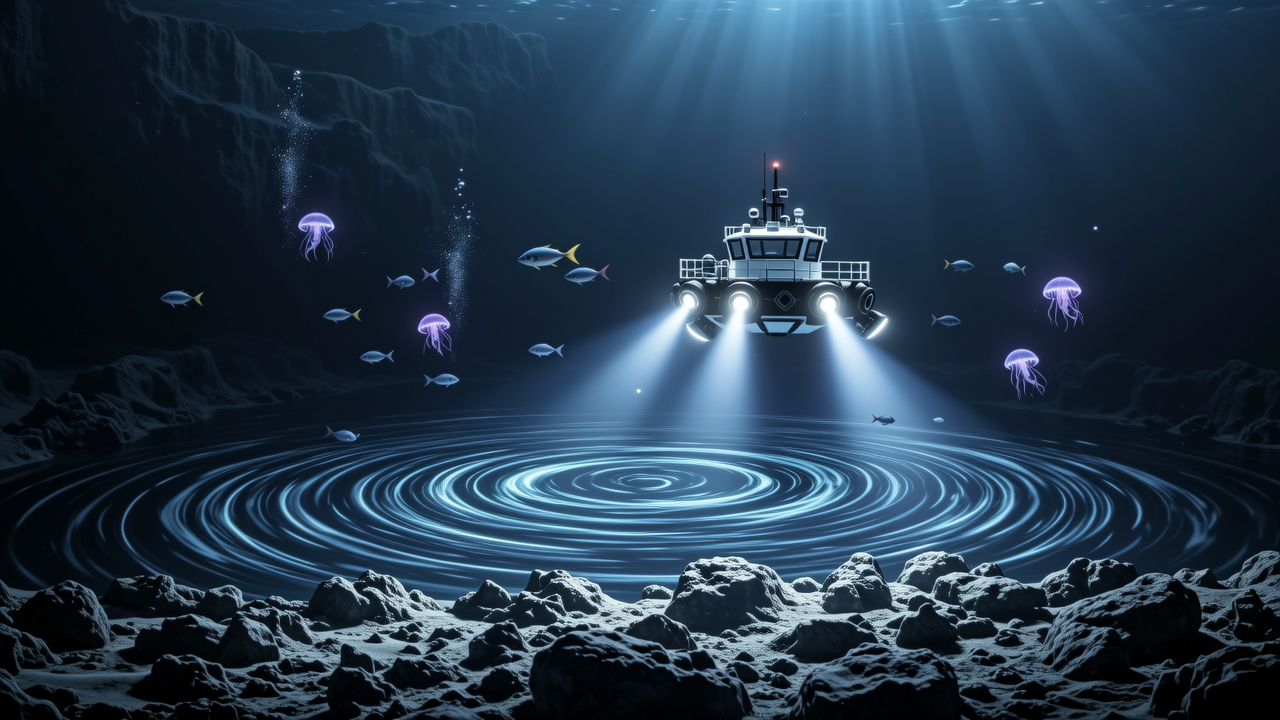
The Mariana Trench, located in the northwest Pacific Ocean near the Mariana Islands in the north, is the deepest known point on Earth's surface. Its deepest point, known as the Challenger Deep, is measured at approximately 10,935 meters or nearly 11 kilometers below sea level. If Mount Everest were placed in this trench, its peak would still be more than one kilometer below sea level.
At this incredible depth, water pressure reaches levels that are hard for the human mind to imagine. Pressure increases at a rate of about one atmosphere (101,325 Pascals or 14.7 pounds per square inch) for every 10 meters of depth. At a depth of 11 km, the pressure reaches approximately 1,100 atmospheres — more than 1,100 times the atmospheric pressure at sea level.
To understand how extreme this pressure is, imagine 50 Boeing 747 airplanes sitting on the palm of your hand. Or imagine the weight of the entire Eiffel Tower pressing on every corner of a one-dollar coin. This pressure is enough to crush a regular submarine like crushing an empty soda can. A human body not protected will be crushed instantly — bones will break, fluids in the body will compress, and lungs will collapse before a person even realizes what is happening.
Yet, astonishingly, life still exists at this extreme depth. Various organisms have been found in the Challenger Deep, including amphipod crustaceans, sea snails, and even some species of bacteria. How do these creatures survive under such immense pressure? The secret lies in extraordinary biological adaptations.
Unlike humans, who have air-filled cavities (such as lungs and sinuses) that can be crushed by pressure, many deep-sea marine organisms have no air cavities at all. Their bodies are filled with fluid and tissue that can compress and then return to their original shape. Their enzymes and proteins have also evolved to function normally under extremely high pressure — enzymes that would become stiff and non-functional at surface pressure can work effectively in this deadly depth.
For humans to explore this depth, special vehicles are required that are designed to withstand the extraordinary pressure. Bathyspheres and research submarines are built with thick steel walls or titanium spheres to create a normal pressure environment inside. In 1960, Jacques Piccard and Don Walsh became the first humans to reach the Challenger Deep using the bathyscaphe Trieste. In 2012, explorer and filmmaker James Cameron descended alone in the DSV Deepsea Challenger, spending several hours exploring the trench floor.
Studies of the Mariana Trench have revealed a unique ecosystem and various organisms previously unknown to science. These discoveries prove that life can exist in the most extreme conditions, and they open the possibility that life may exist in oceans beneath the ice on gas giant moons such as Europa and Enceladus.
## Science Facts #86: Water Pressure at 11km Depth - Mariana Trench. At a depth of 11 kilometers in the Mariana Trench, water pressure reaches over 1,100 atmospheres — equivalent to the weight of 50 jumbo jets on every square inch of your body.. The Mariana Trench, located in the northwest Pacific Ocean near the Mariana Islands in the north, is the deepest known point on Earth's surface. Its deepest point, known as the Challenger Deep, is measured at approximately 10,935 meters or nearly 11 kilometers below sea level. If Mount Everest were placed in this trench, its peak would still be more than one kilometer below sea level.
At this incredible depth, water pressure reaches levels that are hard for the human mind to imagine. Pressure increases at a rate of about one atmosphere 101,325 Pascals or 14.7 pounds per square inch for every 10 meters of depth. At a depth of 11 km, the pressure reaches approximately 1,100 atmospheres — more than 1,100 times the atmospheric pressure at sea level.
To understand how extreme this pressure is, imagine 50 Boeing 747 airplanes sitting on the palm of your hand. Or imagine the weight of the entire Eiffel Tower pressing on every corner of a one-dollar coin. This pressure is enough to crush a regular submarine like crushing an empty soda can. A human body not protected will be crushed instantly — bones will break, fluids in the body will compress, and lungs will collapse before a person even realizes what is happening.
Yet, astonishingly, life still exists at this extreme depth. Various organisms have been found in the Challenger Deep, including amphipod crustaceans, sea snails, and even some species of bacteria. How do these creatures survive under such immense pressure? The secret lies in extraordinary biological adaptations.
Unlike humans, who have air-filled cavities such as lungs and sinuses that can be crushed by pressure, many deep-sea marine organisms have no air cavities at all. Their bodies are filled with fluid and tissue that can compress and then return to their original shape. Their enzymes and proteins have also evolved to function normally under extremely high pressure — enzymes that would become stiff and non-functional at surface pressure can work effectively in this deadly depth.
For humans to explore this depth, special vehicles are required that are designed to withstand the extraordinary pressure. Bathyspheres and research submarines are built with thick steel walls or titanium spheres to create a normal pressure environment inside. In 1960, Jacques Piccard and Don Walsh became the first humans to reach the Challenger Deep using the bathyscaphe Trieste. In 2012, explorer and filmmaker James Cameron descended alone in the DSV Deepsea Challenger, spending several hours exploring the trench floor.
Studies of the Mariana Trench have revealed a unique ecosystem and various organisms previously unknown to science. These discoveries prove that life can exist in the most extreme conditions, and they open the possibility that life may exist in oceans beneath the ice on gas giant moons such as Europa and Enceladus.