🌍 Global coverage 24/7 • 🏯 East Asia: China, Japan, Korea • 🛕 South Asia: India • 🏰 Europe • 🗽 Americas • 🌍 Africa • 🕌 Middle East • 🇵🇸 Palestine Solidarity •
This article is a translation from the original language.
🧠 Did You Know
This 2,500-Year-Old Road Is Still in Use, You May Have Passed Through It
Grand Trunk Road is not just an ordinary highway. Spanning back to the time of Buddha, paved by emperors, and now connecting four Asian countries, this 3,655 km highway holds an extraordinary history. From merchant journeys to military movements, it is the lifeline of the continent that still beats today.
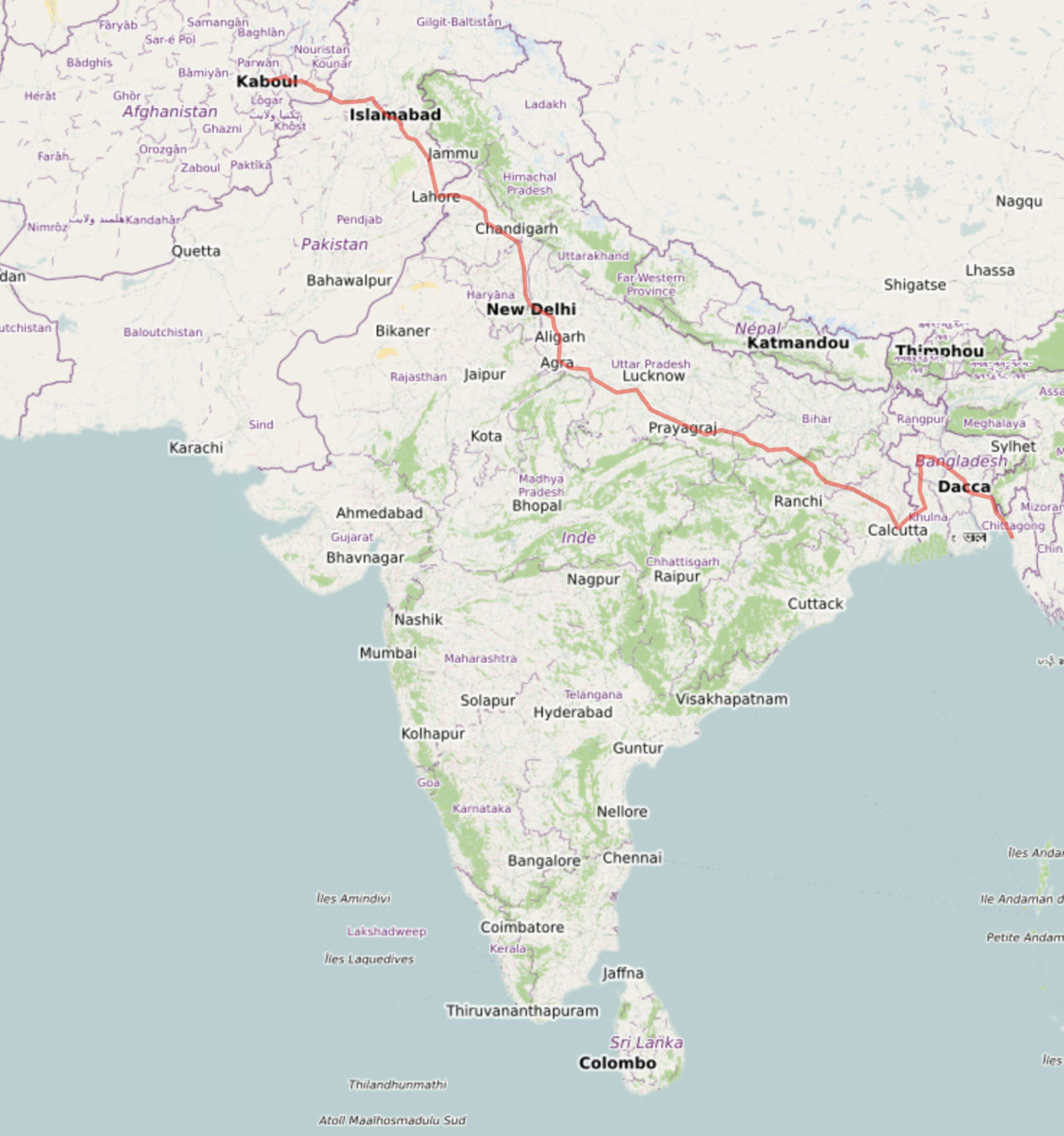
Image: Foto: Wikipedia — Grand Trunk Road (CC BY-SA 4.0)
AI
1. The Oldest Functioning Road in Asia
Grand Trunk Road (GTR) is not just a highway; it is a life artery that has been beating for more than 2,500 years. If you drive from Bangladesh to Afghanistan today, you are actually following the footsteps of merchants, emperors, and ancient heroes. The road starts at Teknaf, Bangladesh, which borders Myanmar, crosses Chittagong and Dhaka, then enters India through Kolkata. From there, it passes through Kanpur, Prayagraj, Agra, Aligarh, Ghaziabad, Delhi, Amritsar, Chandigarh, and continues to Lahore, Rawalpindi, and Peshawar in Pakistan, finally reaching Kabul, Afghanistan. The total distance is about 3,655 kilometers — comparable to the distance from London to Baghdad. However, what makes it unique is its continuous use since pre-Christian times until this digital era.
2. Built on the Ancient 'Uttarapatha' Route of the Buddha Era
The history of GTR began with the ancient route known as Uttarapatha (Sanskrit: उत्तरापथ, meaning "the northern road"). This route was already used in the 3rd century BCE when the Maurya Empire under the rule of Emperor Ashoka expanded. Ashoka not only extended the road from the banks of the Ganges River to the northwest border of India but also planted stone pillars and built rest houses for travelers. More interestingly, this route is mentioned in Buddhist texts as one of the five main trade routes in the small Indian subcontinent. Merchants from Taxila, an ancient center of learning, would travel along Uttarapatha to sell jewelry, textiles, and spices throughout the region. Imagine, the same path once traveled by monks and merchants two millennia ago is now traversed by container trucks and modern vehicles.
3. Sher Shah Suri: The First Architect of the Modern Highway
In the 16th century, this ancient road received a new breath when Emperor Sher Shah Suri of the Suri Empire ordered its reconstruction and realignment. He, known for his efficient administration, changed the route from Sonargaon (now in Bangladesh) to Rohtas (in Pakistan). Sher Shah Suri not only built a straighter and safer road but also introduced a postal system (dak chowki) that allowed fast correspondence between Delhi and Bengal. He also planted trees along the road as shelter and markers. At regular intervals, caravanserais — an ancient type of motel — were built for merchants to rest. These innovations made travel more organized and secure from robbery. Indeed, the British later reused this concept when they expanded the road in the 19th century.
4. The British Era: From Dusty Roads to Paved Highways
When the British took control of India, they recognized the strategic importance of GTR. Between 1833 and 1860, the road was extensively renovated. It was widened, paved with gravel (later tar), and equipped with permanent bridges. The British used it to transport troops, cannons, and supplies between Calcutta (the capital of British India at the time) and Peshawar on the Afghan border. The road also became the backbone of the colonial postal and trade system. During this period, GTR was called "The Great Road" or "The Long Walk" by British soldiers. Interestingly, the road also witnessed large movements during World War II, when Allied forces used it to defend the northwest border of India from the Nazi-German threat attempting to approach India through Afghanistan.
5. A Trade and Cultural Road That Never Dies
This road is more than just physical infrastructure; it is a channel for cultural and economic exchange. For centuries, GTR has enabled merchants to bring spices from southern India, silk from Bengal, horses from Central Asia, and gemstones from Afghanistan. This exchange not only enriched the economy but also spread religion, language, and ideas. For example, Buddhism spread from India to Central and East Asia through this route, while the influence of Islam from Persia and Afghanistan entered the Indian subcontinent through the same road. Along GTR, you can find mosques, temples, gurdwaras, and churches standing side by side — evidence of religious tolerance resulting from cultural interactions. Famous travelers like Ibn Battuta and Xuanzang (a Chinese Buddhist traveler) also recorded their journeys through this road.
6. Grand Trunk Road Today: A Historic Future
Today, GTR remains the lifeline of transportation in South Asia. In Bangladesh, it is known as N1 (national highway), a busy road from Teknaf to Dhaka. In India, it is part of the modern National Highways (NH 19, NH 44, and others) with multiple lanes and lighting. In Pakistan, it is known as N-5 from Lahore to Peshawar. However, the original route is still respected; in some places, you can still see old stones from the British era, old banyan trees, and caravanserais that have been converted into gas stations or restaurants. Even UNESCO once proposed GTR as a World Heritage Site, although it has not been fully recognized yet. For millions of people who use it every day, from market traders to truck drivers, GTR is not just a road — it is the lifeblood that continues to flow with history, trade, and hope from one generation to the next.
This 2,500-Year-Old Road Is Still in Use, You May Have Passed Through It. Grand Trunk Road is not just an ordinary highway. Spanning back to the time of Buddha, paved by emperors, and now connecting four Asian countries, this 3,655 km highway holds an extraordinary history. From merchant journeys to military movements, it is the lifeline of the continent that still beats today.. 1. The Oldest Functioning Road in Asia
Grand Trunk Road GTR is not just a highway; it is a life artery that has been beating for more than 2,500 years. If you drive from Bangladesh to Afghanistan today, you are actually following the footsteps of merchants, emperors, and ancient heroes. The road starts at Teknaf, Bangladesh, which borders Myanmar, crosses Chittagong and Dhaka, then enters India through Kolkata. From there, it passes through Kanpur, Prayagraj, Agra, Aligarh, Ghaziabad, Delhi, Amritsar, Chandigarh, and continues to Lahore, Rawalpindi, and Peshawar in Pakistan, finally reaching Kabul, Afghanistan. The total distance is about 3,655 kilometers — comparable to the distance from London to Baghdad. However, what makes it unique is its continuous use since pre-Christian times until this digital era.
2. Built on the Ancient 'Uttarapatha' Route of the Buddha Era
The history of GTR began with the ancient route known as Uttarapatha Sanskrit: उत्तरापथ, meaning "the northern road" . This route was already used in the 3rd century BCE when the Maurya Empire under the rule of Emperor Ashoka expanded. Ashoka not only extended the road from the banks of the Ganges River to the northwest border of India but also planted stone pillars and built rest houses for travelers. More interestingly, this route is mentioned in Buddhist texts as one of the five main trade routes in the small Indian subcontinent. Merchants from Taxila, an ancient center of learning, would travel along Uttarapatha to sell jewelry, textiles, and spices throughout the region. Imagine, the same path once traveled by monks and merchants two millennia ago is now traversed by container trucks and modern vehicles.
3. Sher Shah Suri: The First Architect of the Modern Highway
In the 16th century, this ancient road received a new breath when Emperor Sher Shah Suri of the Suri Empire ordered its reconstruction and realignment. He, known for his efficient administration, changed the route from Sonargaon now in Bangladesh to Rohtas in Pakistan . Sher Shah Suri not only built a straighter and safer road but also introduced a postal system dak chowki that allowed fast correspondence between Delhi and Bengal. He also planted trees along the road as shelter and markers. At regular intervals, caravanserais — an ancient type of motel — were built for merchants to rest. These innovations made travel more organized and secure from robbery. Indeed, the British later reused this concept when they expanded the road in the 19th century.
4. The British Era: From Dusty Roads to Paved Highways
When the British took control of India, they recognized the strategic importance of GTR. Between 1833 and 1860, the road was extensively renovated. It was widened, paved with gravel later tar , and equipped with permanent bridges. The British used it to transport troops, cannons, and supplies between Calcutta the capital of British India at the time and Peshawar on the Afghan border. The road also became the backbone of the colonial postal and trade system. During this period, GTR was called "The Great Road" or "The Long Walk" by British soldiers. Interestingly, the road also witnessed large movements during World War II, when Allied forces used it to defend the northwest border of India from the Nazi-German threat attempting to approach India through Afghanistan.
5. A Trade and Cultural Road That Never Dies
This road is more than just physical infrastructure; it is a channel for cultural and economic exchange. For centuries, GTR has enabled merchants to bring spices from southern India, silk from Bengal, horses from Central Asia, and gemstones from Afghanistan. This exchange not only enriched the economy but also spread religion, language, and ideas. For example, Buddhism spread from India to Central and East Asia through this route, while the influence of Islam from Persia and Afghanistan entered the Indian subcontinent through the same road. Along GTR, you can find mosques, temples, gurdwaras, and churches standing side by side — evidence of religious tolerance resulting from cultural interactions. Famous travelers like Ibn Battuta and Xuanzang a Chinese Buddhist traveler also recorded their journeys through this road.
6. Grand Trunk Road Today: A Historic Future
Today, GTR remains the lifeline of transportation in South Asia. In Bangladesh, it is known as N1 national highway , a busy road from Teknaf to Dhaka. In India, it is part of the modern National Highways NH 19, NH 44, and others with multiple lanes and lighting. In Pakistan, it is known as N-5 from Lahore to Peshawar. However, the original route is still respected; in some places, you can still see old stones from the British era, old banyan trees, and caravanserais that have been converted into gas stations or restaurants. Even UNESCO once proposed GTR as a World Heritage Site, although it has not been fully recognized yet. For millions of people who use it every day, from market traders to truck drivers, GTR is not just a road — it is the lifeblood that continues to flow with history, trade, and hope from one generation to the next.
---
Reference: Grand Trunk Road — Wikipedia https://en.wikipedia.org/wiki/Grand Trunk Road