First: Unchambered Barrows — What Lies Behind the Name?
Have you ever wondered, in the vast grasslands of Britain or along the coast of Brittany, about earth mounds rising three meters high, stretching 50 meters long? They are not ordinary hills. They are tombs, but not ordinary tombs. The 'unchambered long barrow' is one of the most puzzling structures in Neolithic archaeology. Why? Because its name itself is a riddle: 'unchambered' means no stone chamber inside. But how can a tomb have no chamber? Don't the dead need to be placed in something? The answer is more complex than you might think.
Second: First Evidence — Where Were These Barrows Found?
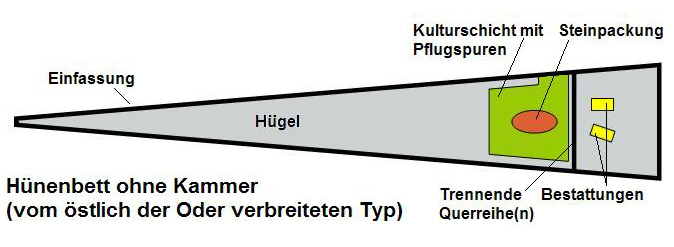
Thirty years of research have mapped these barrows in three main regions: the British Isles, a strip of land in Brittany (Northwestern France), and northern Europe as far as the Vistula River in Poland. In Britain, they are called 'non-megalithic long barrows' or 'unchambered long cairns'. In Germany, they are known as 'kammerloses Hünenbett' — chamberless giant beds. In Poland, they are 'Niedźwiedź type graves' (NTT). More surprising discoveries occurred in the 1980s when archaeologists found Passy-type barrows in Essonne, France, part of the Cerny culture. These are not megalithic structures — no large stones were used. It was just earth, wood, and bone. The question is: how could prehistoric societies excavate, transport, and arrange thousands of tons of earth without modern technology?
Third: Second Evidence — Who Was Buried and How?
Archaeological excavations have revealed the remains of individuals placed within the barrows without stone chambers. The burial process was a complex ritual: bodies might have been left to decompose on the ground, then the bones were collected and placed within the mound. Isotope analysis suggests that these individuals may have come from various different local groups. Some died elsewhere and were brought home. Some were buried with grave goods like copper beads and stone axes. But none of them were placed in a stone chamber — because there was no stone chamber. This raises the question: what was the true function of these mounds? Were they merely piles of earth to mark status? Or were they part of the cosmological map of Neolithic societies?
Fourth: Third Evidence — Why Long and Not Round?
Archaeologists compare these long barrows to the more common round mounds. This difference in shape is not merely aesthetic. Long barrows might symbolize the journey of the spirit to another realm, or they might mimic the shape of the longhouses inhabited by Neolithic societies. In the Passy Valley, the long barrows are aligned east-west, suggesting astronomical significance. Recent studies using ground-penetrating radar (GPR) indicate that some of these barrows were built over earlier wooden structures — possibly a wooden house or temple. This means the mounds were not just tombs, but monuments that transformed sacred spaces into eternal earth.
Fifth: The Boldest Hypothesis — Societies Without Kings, But With Monuments
The 'unchambered long barrow' is evidence that Neolithic societies were not disorganized, primitive groups. They possessed knowledge of geometry, earth engineering, and high social cooperation. There is no evidence of central hierarchy — no palaces or large cities — yet they were able to build structures that have lasted over 6,000 years. This challenges the modern assumption that large monuments can only be built by royal societies. These barrows might have been the result of community-wide cooperation to honor common ancestors. They are monuments of ancient democracy — built by many, for all.
Conclusion: What Do We Still Not Know?
Each mound is an unfinished mystery. There are no written records, only bones and earth. What we know is only through residual artifacts and sediment layers. But one thing is certain: the 'unchambered long barrow' is not an empty tomb. It is an earth library, holding stories of people who lived thousands of years before us. Every time an archaeologist excavates one, they open a new page in a lost book. And we, the readers of the 21st century, can only stand in awe at how sophisticated those called 'primitive' were.
---
Reference: Unchambered long barrow — Wikipedia
Mystery of the 6,000-Year-Old Giant Earth Mounds: Who Lies Within?. Found across Britain, France, and northern Europe, there are thousands of long earth mounds with no stone chambers inside. These Neolithic structures, known as 'unchambered long barrows', hold secrets about the ancient societies that built them. Who was buried there and why no stone chambers? This article delves into the latest research to uncover the true purpose of these mysterious monuments.. First: Unchambered Barrows — What Lies Behind the Name?
Have you ever wondered, in the vast grasslands of Britain or along the coast of Brittany, about earth mounds rising three meters high, stretching 50 meters long? They are not ordinary hills. They are tombs, but not ordinary tombs. The 'unchambered long barrow' is one of the most puzzling structures in Neolithic archaeology. Why? Because its name itself is a riddle: 'unchambered' means no stone chamber inside. But how can a tomb have no chamber? Don't the dead need to be placed in something? The answer is more complex than you might think.
Second: First Evidence — Where Were These Barrows Found?
Thirty years of research have mapped these barrows in three main regions: the British Isles, a strip of land in Brittany Northwestern France , and northern Europe as far as the Vistula River in Poland. In Britain, they are called 'non-megalithic long barrows' or 'unchambered long cairns'. In Germany, they are known as 'kammerloses Hünenbett' — chamberless giant beds. In Poland, they are 'Niedźwiedź type graves' NTT . More surprising discoveries occurred in the 1980s when archaeologists found Passy-type barrows in Essonne, France, part of the Cerny culture. These are not megalithic structures — no large stones were used. It was just earth, wood, and bone. The question is: how could prehistoric societies excavate, transport, and arrange thousands of tons of earth without modern technology?
Third: Second Evidence — Who Was Buried and How?
Archaeological excavations have revealed the remains of individuals placed within the barrows without stone chambers. The burial process was a complex ritual: bodies might have been left to decompose on the ground, then the bones were collected and placed within the mound. Isotope analysis suggests that these individuals may have come from various different local groups. Some died elsewhere and were brought home. Some were buried with grave goods like copper beads and stone axes. But none of them were placed in a stone chamber — because there was no stone chamber. This raises the question: what was the true function of these mounds? Were they merely piles of earth to mark status? Or were they part of the cosmological map of Neolithic societies?
Fourth: Third Evidence — Why Long and Not Round?
Archaeologists compare these long barrows to the more common round mounds. This difference in shape is not merely aesthetic. Long barrows might symbolize the journey of the spirit to another realm, or they might mimic the shape of the longhouses inhabited by Neolithic societies. In the Passy Valley, the long barrows are aligned east-west, suggesting astronomical significance. Recent studies using ground-penetrating radar GPR indicate that some of these barrows were built over earlier wooden structures — possibly a wooden house or temple. This means the mounds were not just tombs, but monuments that transformed sacred spaces into eternal earth.
Fifth: The Boldest Hypothesis — Societies Without Kings, But With Monuments
The 'unchambered long barrow' is evidence that Neolithic societies were not disorganized, primitive groups. They possessed knowledge of geometry, earth engineering, and high social cooperation. There is no evidence of central hierarchy — no palaces or large cities — yet they were able to build structures that have lasted over 6,000 years. This challenges the modern assumption that large monuments can only be built by royal societies. These barrows might have been the result of community-wide cooperation to honor common ancestors. They are monuments of ancient democracy — built by many, for all.
Conclusion: What Do We Still Not Know?
Each mound is an unfinished mystery. There are no written records, only bones and earth. What we know is only through residual artifacts and sediment layers. But one thing is certain: the 'unchambered long barrow' is not an empty tomb. It is an earth library, holding stories of people who lived thousands of years before us. Every time an archaeologist excavates one, they open a new page in a lost book. And we, the readers of the 21st century, can only stand in awe at how sophisticated those called 'primitive' were.
---
Reference: Unchambered long barrow — Wikipedia https://en.wikipedia.org/wiki/Unchambered long barrow