AI
Kandungan Ditaja (Sponsored)
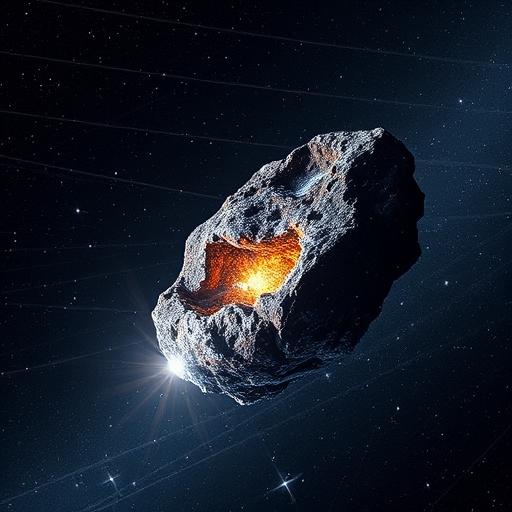
Quasicrystal in Meteorite Khatyrka: The Impossible Atomic Structure Challenging Crystallography Laws and the Origin of the Universe. The discovery of the first naturally occurring quasicrystal in the Khatyrka meteorite from Russia has shocked the scientific community. This impossible atomic structure not only challenges classical crystallography laws but also provides new evidence about the early formation of the universe. Research published in the *Science* and *Nature Communications* journals reveals how quasicrystals can form naturally through high-speed meteorite collisions, opening new perspectives in astrophysics and materials science.. Introduction: What is Quasicrystal and Why is it Considered Impossible?
For centuries, crystallographers have held fast to the law that all crystals must have a repeating atomic arrangement in three dimensions. This law, known as Bravais' law, states that there are only 14 possible crystal lattices. However, in 1984, Israeli scientist Dan Shechtman shocked the world with the discovery of a material with a regular but non-repeating atomic arrangement – quasicrystal. This discovery was so controversial that Shechtman was initially expelled from his research group. However, he was eventually awarded the Nobel Prize in Chemistry in 2011. Although quasicrystals have been synthesized in the lab, the main question remained: can quasicrystals occur naturally in the universe? The answer came from the most unexpected place – a small meteorite found in the Koryak Mountains, eastern Russia.
Discovery of the Khatyrka Meteorite: From Gold Dust to Weird Atomic Structure
In 1979, a gold prospector named Ivan B. found a small meteorite fragment on the banks of the Khatyrka River. For several decades, this sample was stored without realizing its value. It wasn't until 2007 that a mineralogist from the University of Florence, Italy, examined the sample and found mineral grains with five-fold rotational symmetry – a characteristic impossible in regular crystals. An international research team led by Professor Paul Steinhardt from Princeton University later confirmed that the mineral was a naturally occurring quasicrystal, the first of its kind. This discovery was published in the Science journal in 2009, with the title "Natural Quasicrystal: A New Mineral from the Khatyrka Meteorite".
Research Methodology: Electron Microscopy and Atomic Structure Analysis
The research team used various advanced techniques to confirm the quasicrystal structure. First, electron transmission microscopy TEM was used to observe the electron diffraction pattern, which showed icosahedral symmetry – a five-fold rotational symmetry forbidden in regular crystals. Second, X-ray diffraction XRD confirmed that the atoms in the mineral were arranged in a regular but non-repeating pattern. Third, scanning electron microscopy SEM with energy-dispersive spectroscopy EDS was used to determine the chemical composition, consisting of aluminum, copper, and iron – a composition never seen in any natural mineral before. The mineral was named "icosahedrite" Al63Cu24Fe13 after the icosahedron shape that forms its basis.
Results and Implications: Challenging Crystallography Laws and Astrophysics
The discovery of icosahedrite in the Khatyrka meteorite has profound implications. First, it proves that quasicrystals can occur naturally in the universe, not just in the lab. Second, isotopic analysis shows that the meteorite originated from a primitive asteroid formed about 4.5 billion years ago. Third, the presence of quasicrystals in the meteorite suggests that their formation requires extremely high temperatures and pressures, only achievable through high-speed asteroid collisions. Further research published in Nature Communications in 2016 by the same team found that quasicrystals form through a process called "impact shock" – a shockwave generated by meteorite collisions. This process causes atoms to arrange in a quasicrystal structure stable under high pressure.
Scientific Debate: Is Quasicrystal Really Stable?
Although this discovery was widely accepted, there is still debate about the long-term stability of quasicrystals. Some scientists argue that quasicrystals may only be stable under high pressure and will decay into regular crystals when pressure is released. However, the Steinhardt team showed that icosahedrite remains stable at atmospheric pressure, although it may take an extremely long time to decay. Thermodynamic calculations showed that quasicrystals have a lower free energy than alternative crystal phases at certain temperatures and pressures, making them metastably stable. This means that quasicrystals can exist for billions of years if the environment remains unchanged.
Applications and Future: From Space to Earth Technology
The discovery of naturally occurring quasicrystals not only has fundamental implications for basic science but also has potential technological applications. Synthetic quasicrystals have been used in anti-adhesive coatings, high-strength alloys, and thermal insulation. Natural quasicrystals may provide clues to creating new materials with unique properties. Additionally, this discovery opens a new field in astromineralogy – the study of minerals in space. Space missions like OSIRIS-REx and Hayabusa2, which bring back asteroid samples, may search for quasicrystals. If quasicrystals are found in other asteroids, they could serve as markers for early solar system collisions.
Conclusion: A Step Towards Understanding the Universe
The discovery of quasicrystals in the Khatyrka meteorite serves as a reminder that the universe still holds many surprises challenging our understanding. What was considered impossible by classical science turns out to occur naturally. This research not only changes our view of atomic structure but also provides insights into the violent processes that formed planets and asteroids. As Professor Steinhardt said, "The universe is a more creative laboratory than any human laboratory." This discovery opens the door to new research on exotic materials in space and may one day lead to technologies we cannot yet imagine.
Tags: