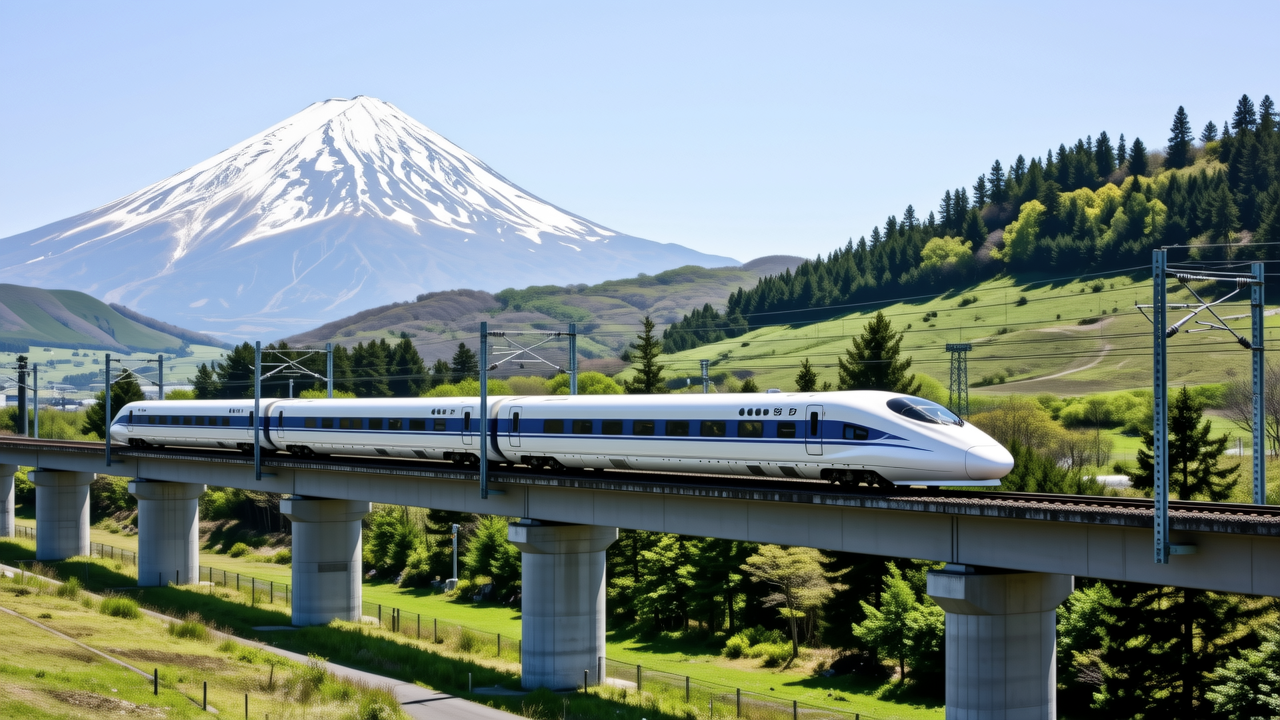
Yamanashi, June 24 — Japan, which has long led the world in high-speed rail technology since the introduction of Shinkansen in 1964, has once again made history as their new SCMaglev magnetic levitation train recorded a new speed record during testing on the Yamanashi test line. This train, which hovers above a magnetic track without any physical contact, reached a top speed of 610 kilometers per hour — surpassing the previous record and making it the fastest land train in human history.
The maglev technology used by Japan employs the principle of superconductivity — superconducting coils on the train interact with magnetic loops on the track, creating lift and propulsion entirely through magnetic energy without any moving parts touching. The absence of mechanical friction allows speeds far exceeding the limits achievable by conventional wheel-based trains.
The Chuo Shinkansen project, which will connect Tokyo with Nagoya and then Osaka using this maglev technology, is now in an active construction phase. Once completed, the journey between Tokyo and Osaka, which currently takes two hours and 15 minutes with conventional Shinkansen, will be possible in just 67 minutes. This means that major Japanese cities within a 500-kilometer range will feel closer to each other than ever before.
In terms of safety, this maglev system has been designed with multiple layers of highly advanced safety systems. Even if there is an electrical failure, the train will be able to safely glide to the nearest station using stored kinetic energy. A computer control system operating in microseconds ensures that the distance between trains operating on the same route is always at a safe level.
Other countries, including the United States, India, and several European nations, have expressed interest in importing Japan's maglev technology to develop ultra-fast transportation systems in their own countries, opening up significant business opportunities for Japan in technology exports.
Shinkansen 2.0: Japan Tests New Generation Magnetic Bullet Train That Is Faster. Japan has set a new speed record for maglev trains in the latest test, opening a new era in ultra-fast land transportation that promises a Tokyo-Osaka journey in 67 minutes.. Yamanashi, June 24 — Japan, which has long led the world in high-speed rail technology since the introduction of Shinkansen in 1964, has once again made history as their new SCMaglev magnetic levitation train recorded a new speed record during testing on the Yamanashi test line. This train, which hovers above a magnetic track without any physical contact, reached a top speed of 610 kilometers per hour — surpassing the previous record and making it the fastest land train in human history.
The maglev technology used by Japan employs the principle of superconductivity — superconducting coils on the train interact with magnetic loops on the track, creating lift and propulsion entirely through magnetic energy without any moving parts touching. The absence of mechanical friction allows speeds far exceeding the limits achievable by conventional wheel-based trains.
The Chuo Shinkansen project, which will connect Tokyo with Nagoya and then Osaka using this maglev technology, is now in an active construction phase. Once completed, the journey between Tokyo and Osaka, which currently takes two hours and 15 minutes with conventional Shinkansen, will be possible in just 67 minutes. This means that major Japanese cities within a 500-kilometer range will feel closer to each other than ever before.
In terms of safety, this maglev system has been designed with multiple layers of highly advanced safety systems. Even if there is an electrical failure, the train will be able to safely glide to the nearest station using stored kinetic energy. A computer control system operating in microseconds ensures that the distance between trains operating on the same route is always at a safe level.
Other countries, including the United States, India, and several European nations, have expressed interest in importing Japan's maglev technology to develop ultra-fast transportation systems in their own countries, opening up significant business opportunities for Japan in technology exports.