Silence in the Campus Corridor
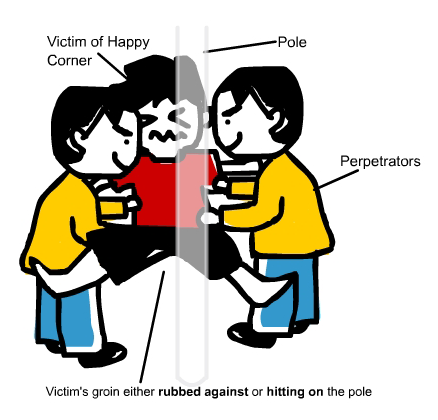
The clock shows 12:30 PM. Male students from a university in China rush out of the lecture hall. The atmosphere is lively with laughter. Suddenly, a student named Wei is ambushed from behind. Four of his friends grab his arms and legs. In an instant, Wei is lifted into the air. His legs are spread apart. His eyes widen in fear.
"Don't! Please don't!" he shouts half-jokingly, but his tone contains panic. His friends ignore him. They run toward the iron pole in the center of the courtyard. The 10-centimeter-wide steel pole has been a silent witness to dozens of previous 'victims.' With one swing, Wei's sensitive area is smashed against the pole—once, twice, three times. The dry 'thud' echoes. Laughter breaks the atmosphere. Wei groans in pain while smiling bitterly.
This scene is not a movie. It is reality behind the term 'Happy Corner' or 'Aluba.'
Origins: From Rough Jokes to 'Tradition'
'Happy Corner' or 'Aluba' (阿鲁巴) originated among male students in Taiwan and China in the 1990s. No one knows for sure who started it. However, it spread like wildfire across major universities in mainland China, Hong Kong, Macau, and Malaysia.
Initially, it was a form of 'game' or 'ritual' to celebrate something—like the end of exams, birthdays, or simply to strengthen male friendships. The victim is usually lifted by several people, then their groin is smashed against a pole, door, or any vertical object. The harder the hit, the more 'happy' it is said to be.
However, psychologically, 'Happy Corner' is actually a manifestation of patriarchal culture and toxic masculinity among teenage boys. It is a way to 'prove' bravery and physical endurance—that a man can withstand pain without complaining. A victim who smiles after being hit is considered a 'real man.' A victim who cries or gets angry is seen as weak and becomes a more frequent target.
Psychology Behind 'Happy Corner': Why Do They Like It?
Why can an activity that is clearly painful and dangerous become a 'tradition' that is maintained? The answer lies in group psychology and the pressure to be accepted.
First, it creates a unique bond within the male group. In anthropological studies, shared painful rituals are often used to strengthen solidarity. When someone goes through 'Happy Corner,' they are considered officially initiated into the group. It is a form of harsh initiation, but it is seen as the 'price' to be accepted.
Second, it is an outlet for stress. Male students in China and Malaysia face extraordinary academic pressure. 'Happy Corner' becomes a channel to release frustration. When they hit the victim, they symbolically 'hit' their own stress. The relief after doing so is misinterpreted as 'happiness.'
Third, it is a power game. In every group, there is always a hierarchy. 'Happy Corner' is often targeted at individuals who are quieter or less popular. It is a way for the dominant party to assert control. Although the victim smiles, there is a subtle element of coercion. They know if they refuse, they will be ostracized.
Unspoken Physical and Psychological Impacts
Although considered a 'joke,' 'Happy Corner' can have serious consequences. Physically, a strong hit to the groin can cause damage to the testicles, bladder, or thigh. Cases of pelvic fractures, blood clots in the scrotum, and erection problems have been reported in university clinics. In extreme cases, it can lead to temporary or permanent infertility.
Psychologically, the effects are quieter but deeper. Victims who are frequently targeted may experience social anxiety, nightmares, and loss of self-confidence. They may avoid areas with poles or feel afraid every time they enter the campus. Ironically, many victims do not report it out of fear of stigma. They would rather suffer silently than be seen as not 'sporting.'
A Malaysian student I met (name given as Amir) shared: "In Form 4, I was subjected to Happy Corner every time I finished an exam. At first, I laughed too. But later, I started feeling pain when urinating. I was ashamed to tell the teacher. I just hoped they would get bored." Amir is now 23 years old and still has a mild trauma when seeing poles.
Controversy: Between Tradition and Bullying
In recent years, 'Happy Corner' has started to receive serious attention from educational authorities. In China, some universities have issued clear orders banning this practice. Bullying cases involving 'Happy Corner' have been brought before disciplinary courts. In Malaysia, the Ministry of Education has reminded all institutions to take strict action against any form of hazing.
However, many still defend it. They argue that it is merely 'boys joking around' and no more dangerous than 'kantoi' or 'military-style exercises.' They say as long as it is not excessive, it does not need to be banned. They also claim it strengthens bonds and celebrates joy together.
But these arguments are weak. When someone's enjoyment is built on another person's pain, it is no longer a joke—it is bullying. All jokes require mutual consent. If the victim cannot refuse without fearing exclusion, it is coercion. Tradition cannot be used as an excuse to hurt.
Future: Ending the Culture of Silence
The first step to changing this culture is awareness. Many students are unaware that 'Happy Corner' can be classified as sexual bullying because it targets intimate areas. Schools and universities need to hold awareness sessions about physical boundaries and consent.
Second, teachers and parents need to be vigilant. If a child or student suddenly avoids poles or often holds their groin, do not dismiss it. Ask, talk, and offer support. Do not let them suffer in silence.
Third, students themselves need to be brave enough to speak up. Saying 'no' is not a sign of weakness. It is a sign of maturity. True friendship is not built on pain. True happiness does not require a pole.
Finally, culture only changes when each individual makes a conscious choice. The choice to not hurt. The choice to not be a victim. The choice to create a healthier new tradition—traditions that celebrate with smiles, not with pain.
We can be happy without making anyone a 'Happy Corner.' That is real happiness.
---
Reference: Happy corner — Wikipedia
Abducted, Lifted, and Smashed Against a Pole: The Strange 'Happy Corner' Tradition Among Male Students. Imagine walking on campus when suddenly a group of friends grab you, lift you high, and smash your sensitive area against a metal pole. That is 'Happy Corner' or 'Aluba,' a bizarre hazing tradition that is popular among male students in China and Malaysia. More than just a joke, it has sparked controversy: is it innocent fun or a cruel form of bullying? This article explores its origins, the psychology behind it, and the rarely discussed impact.. Silence in the Campus Corridor
The clock shows 12:30 PM. Male students from a university in China rush out of the lecture hall. The atmosphere is lively with laughter. Suddenly, a student named Wei is ambushed from behind. Four of his friends grab his arms and legs. In an instant, Wei is lifted into the air. His legs are spread apart. His eyes widen in fear.
"Don't! Please don't!" he shouts half-jokingly, but his tone contains panic. His friends ignore him. They run toward the iron pole in the center of the courtyard. The 10-centimeter-wide steel pole has been a silent witness to dozens of previous 'victims.' With one swing, Wei's sensitive area is smashed against the pole—once, twice, three times. The dry 'thud' echoes. Laughter breaks the atmosphere. Wei groans in pain while smiling bitterly.
This scene is not a movie. It is reality behind the term 'Happy Corner' or 'Aluba.'
Origins: From Rough Jokes to 'Tradition'
'Happy Corner' or 'Aluba' 阿鲁巴 originated among male students in Taiwan and China in the 1990s. No one knows for sure who started it. However, it spread like wildfire across major universities in mainland China, Hong Kong, Macau, and Malaysia.
Initially, it was a form of 'game' or 'ritual' to celebrate something—like the end of exams, birthdays, or simply to strengthen male friendships. The victim is usually lifted by several people, then their groin is smashed against a pole, door, or any vertical object. The harder the hit, the more 'happy' it is said to be.
However, psychologically, 'Happy Corner' is actually a manifestation of patriarchal culture and toxic masculinity among teenage boys. It is a way to 'prove' bravery and physical endurance—that a man can withstand pain without complaining. A victim who smiles after being hit is considered a 'real man.' A victim who cries or gets angry is seen as weak and becomes a more frequent target.
Psychology Behind 'Happy Corner': Why Do They Like It?
Why can an activity that is clearly painful and dangerous become a 'tradition' that is maintained? The answer lies in group psychology and the pressure to be accepted.
First, it creates a unique bond within the male group. In anthropological studies, shared painful rituals are often used to strengthen solidarity. When someone goes through 'Happy Corner,' they are considered officially initiated into the group. It is a form of harsh initiation, but it is seen as the 'price' to be accepted.
Second, it is an outlet for stress. Male students in China and Malaysia face extraordinary academic pressure. 'Happy Corner' becomes a channel to release frustration. When they hit the victim, they symbolically 'hit' their own stress. The relief after doing so is misinterpreted as 'happiness.'
Third, it is a power game. In every group, there is always a hierarchy. 'Happy Corner' is often targeted at individuals who are quieter or less popular. It is a way for the dominant party to assert control. Although the victim smiles, there is a subtle element of coercion. They know if they refuse, they will be ostracized.
Unspoken Physical and Psychological Impacts
Although considered a 'joke,' 'Happy Corner' can have serious consequences. Physically, a strong hit to the groin can cause damage to the testicles, bladder, or thigh. Cases of pelvic fractures, blood clots in the scrotum, and erection problems have been reported in university clinics. In extreme cases, it can lead to temporary or permanent infertility.
Psychologically, the effects are quieter but deeper. Victims who are frequently targeted may experience social anxiety, nightmares, and loss of self-confidence. They may avoid areas with poles or feel afraid every time they enter the campus. Ironically, many victims do not report it out of fear of stigma. They would rather suffer silently than be seen as not 'sporting.'
A Malaysian student I met name given as Amir shared: "In Form 4, I was subjected to Happy Corner every time I finished an exam. At first, I laughed too. But later, I started feeling pain when urinating. I was ashamed to tell the teacher. I just hoped they would get bored." Amir is now 23 years old and still has a mild trauma when seeing poles.
Controversy: Between Tradition and Bullying
In recent years, 'Happy Corner' has started to receive serious attention from educational authorities. In China, some universities have issued clear orders banning this practice. Bullying cases involving 'Happy Corner' have been brought before disciplinary courts. In Malaysia, the Ministry of Education has reminded all institutions to take strict action against any form of hazing.
However, many still defend it. They argue that it is merely 'boys joking around' and no more dangerous than 'kantoi' or 'military-style exercises.' They say as long as it is not excessive, it does not need to be banned. They also claim it strengthens bonds and celebrates joy together.
But these arguments are weak. When someone's enjoyment is built on another person's pain, it is no longer a joke—it is bullying. All jokes require mutual consent. If the victim cannot refuse without fearing exclusion, it is coercion. Tradition cannot be used as an excuse to hurt.
Future: Ending the Culture of Silence
The first step to changing this culture is awareness. Many students are unaware that 'Happy Corner' can be classified as sexual bullying because it targets intimate areas. Schools and universities need to hold awareness sessions about physical boundaries and consent.
Second, teachers and parents need to be vigilant. If a child or student suddenly avoids poles or often holds their groin, do not dismiss it. Ask, talk, and offer support. Do not let them suffer in silence.
Third, students themselves need to be brave enough to speak up. Saying 'no' is not a sign of weakness. It is a sign of maturity. True friendship is not built on pain. True happiness does not require a pole.
Finally, culture only changes when each individual makes a conscious choice. The choice to not hurt. The choice to not be a victim. The choice to create a healthier new tradition—traditions that celebrate with smiles, not with pain.
We can be happy without making anyone a 'Happy Corner.' That is real happiness.
---
Reference: Happy corner — Wikipedia https://en.wikipedia.org/wiki/Happy corner