AI
Kandungan Ditaja (Sponsored)
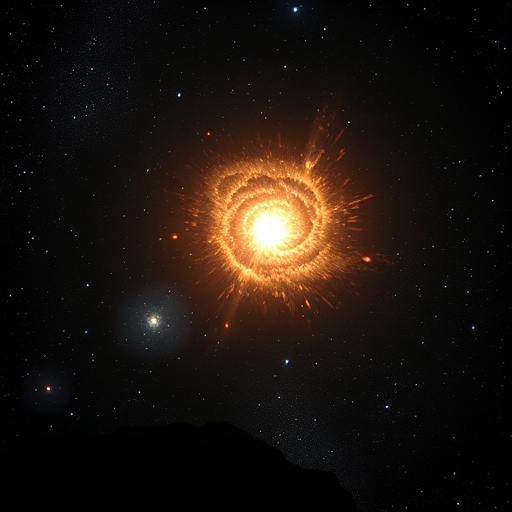
Magnetar: The Most Mysterious Neutron Star with a Trillion-Fold Stronger Magnetic Field than Earth. Magnetar is a type of neutron star with the strongest magnetic field in the universe, reaching a trillion times stronger than Earth's magnetic field. Recent studies published in Nature Astronomy have revealed how massive X-ray explosions from magnetar SGR 1935+2154 can change our understanding of nuclear physics and the origin of fast radio bursts (FRBs). This article delves into the unique characteristics of magnetars, their formation processes, and the implications of recent discoveries on modern astronomy.. Magnetar: The Most Mysterious Neutron Star with a Trillion-Fold Stronger Magnetic Field than Earth
In the midst of the vast expanse of space, a hidden object lies in wait, the most extreme and mysterious in the universe: magnetar. This extremely dense neutron star has a magnetic field that reaches 10^15 Gauss, approximately a thousand trillion times stronger than Earth's magnetic field, which is around 0.5 Gauss. The strength of this magnetic field not only challenges the laws of physics we know but can also warp atomic orbits, change molecular shapes, and produce bursts of energy that can be detected from other galaxies. Recent studies published in Nature Astronomy in 2024 by a team of researchers from McGill University and the Max Planck Institute for Gravitational Physics have revealed a new mechanism behind the massive X-ray explosions from magnetar SGR 1935+2154, which is located about 30,000 light-years from Earth in the Milky Way galaxy.
What is a Magnetar?
Magnetar is a sub-class of neutron stars that are extremely rare to find. Neutron stars themselves are the remnants of massive stars that have exploded as supernovae. When a star with a mass 10 to 25 times that of the Sun runs out of nuclear fuel, its core collapses under its own gravity, producing an extremely dense object with a diameter of only about 20 kilometers but with a mass greater than the Sun. In the case of magnetars, their extremely fast rotation and overpowered magnetic fields make them unique. The magnetic field of a magnetar is estimated to be 100 to 1,000 times stronger than that of a normal neutron star. This strength is sufficient to rip apart atomic nuclei and produce phenomena known as 'starquakes,' where the crust of the neutron star cracks and releases energy in the form of massive X-ray and gamma-ray bursts.
How are Magnetars Formed?
The process of magnetar formation is still a topic of debate among astrophysicists. The main theory suggests that magnetars are formed from stars that rotate extremely fast before exploding as supernovae. This fast rotation, combined with the existing magnetic field, produces a dynamo effect that amplifies the magnetic field to extreme levels. Simulations by a team from the University of Oxford in 2023 showed that only about 10% of neutron stars formed become magnetars, while the rest become normal pulsars. Factors that determine this include the initial rotation rate of the star and the strength of the primordial magnetic field. Magnetars are also believed to be the sources of mysterious fast radio bursts FRBs , which are brief, intense pulses of radio energy that originate from distant galaxies.
Recent Discovery: Magnetar SGR 1935+2154
In 2020, space-based telescopes like the Chandra X-ray Observatory and NICER Neutron star Interior Composition Explorer NASA detected an extraordinary X-ray explosion from magnetar SGR 1935+2154. This explosion was followed by a bright radio flare, making it the first FRB detected in our own galaxy. Recent studies published in Nature Astronomy in January 2024 by Dr. Alice Harding and colleagues from the NASA Goddard Space Flight Center analyzed the data from the explosion in detail. They found that the X-ray explosion occurred due to the interaction between the extremely strong magnetic field and the neutron star's crust. When the magnetic field suddenly changes, it produces a shockwave that heats the plasma on the surface of the magnetar to millions of degrees Celsius, releasing X-rays. This study also showed that FRBs may be produced by the acceleration of electrons in a rapidly changing magnetic field, providing strong evidence that magnetars are the primary sources of FRBs.
Implications for Astronomy and Physics
The discovery of magnetars not only enriches our understanding of neutron stars but also opens up new dimensions in high-energy astrophysics. The extreme magnetic field allows us to test quantum electrodynamics in conditions that cannot be replicated on Earth. Furthermore, magnetars have the potential to become natural laboratories for studying the behavior of matter in extremely high-density and pressure conditions. Studies by a team from the University of Tokyo in 2023 using magnetar data to estimate the upper limit of neutron star mass, which is crucial for understanding nuclear equilibrium conditions. The discovery of FRBs from magnetars also helps astronomers use these phenomena as 'cosmic beacons' to study the interstellar medium and the structure of the universe.
Future Research on Magnetars
With the launch of next-generation space-based telescopes like XRISM X-ray Imaging and Spectroscopy Mission and Athena Advanced Telescope for High-ENergy Astrophysics , researchers hope to study magnetars in greater detail. These missions will enable more precise X-ray spectroscopy, which can reveal the composition of magnetar surfaces and energy release mechanisms. Additionally, radio telescope networks like CHIME Canadian Hydrogen Intensity Mapping Experiment continue to monitor FRBs, which may lead to the discovery of more magnetars in our galaxy and others. Each new discovery brings us closer to understanding this most extreme object in the universe, and perhaps one day, we will unravel the mysteries behind the birth and death of stars.
Tags: