AI
Kandungan Ditaja (Sponsored)
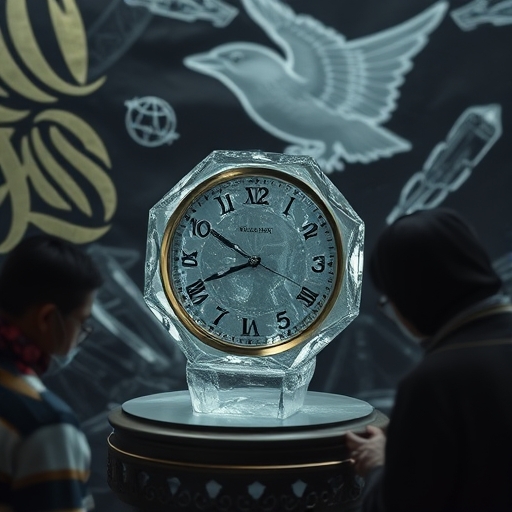
Time Crystal: The Discovery of an Eternal Matter Phase That Oscillates Without Energy, Challenging Classical Physics Laws. Time crystals are a new phase of matter first proposed by Nobel laureate Frank Wilczek in 2012. Unlike ordinary crystals with periodic spatial structures, time crystals exhibit periodic motion in the time dimension without requiring external energy input. Recent experiments by a team from Google Quantum AI and researchers from Princeton University have successfully created and sustained time crystals for several seconds, challenging the second law of thermodynamics and paving the way for applications in quantum computing and ultra-precise atomic clocks.. Introduction: A New Frontier in Condensed Matter Physics
In the world of physics, the discovery of new phases of matter often radically transforms our understanding of the universe. From superconductors to Bose-Einstein condensates, each discovery opens new dimensions in materials science. Now, a more peculiar and surprising phase of matter has been realized in the lab: the time crystal. Unlike ordinary crystals whose atoms are arranged periodically in three-dimensional space, time crystals exhibit periodic arrangements in the time dimension. This means the system spontaneously oscillates at a fixed frequency without any energy consumption, seemingly violating the second law of thermodynamics, which states that entropy must increase or remain constant in a closed system.
Origin of the Time Crystal Concept
The concept of the time crystal was first introduced by Frank Wilczek, the 2004 Nobel Prize in Physics laureate, in a paper in 2012. Wilczek proposed that time translation symmetry could be spontaneously broken in quantum systems, much like spatial translation symmetry is broken in ordinary crystals. In ordinary crystals, atoms take fixed positions in space, breaking the continuous spatial translation symmetry. In a time crystal, the system enters a state that oscillates periodically in time, breaking time translation symmetry. This proposal was initially met with skepticism because it seemed to violate the second law of thermodynamics. However, further studies showed that time crystals could exist in systems not in thermal equilibrium, provided they are periodically driven by an external field.
Breakthrough Experiments by Google Quantum AI
In 2021, a team of researchers from Google Quantum AI, along with Princeton University, Stanford University, and other institutions, successfully created a time crystal using the Sycamore quantum processor. In an experiment published in the journal Nature Communications , they used an array of 20 qubits arranged in a one-dimensional chain. Using precise laser pulses, these qubits interacted with each other and formed a periodically oscillating state. Remarkably, these oscillations continued even after the external pulses were stopped, indicating that the system had reached a stable time crystal phase. This experiment was replicated by an independent team from Harvard University and the University of Maryland, who used ion traps to create time crystals with even higher precision.
The Quantum Mechanism Behind Time Crystals
To understand how time crystals work, we need to delve into quantum mechanics. In quantum systems, particles like atoms or ions can exist in a superposition of states, meaning they exist in multiple states simultaneously. Time crystals leverage a phenomenon known as 'many-body localization,' where interactions between particles prevent the system from reaching thermal equilibrium. When the system is periodically driven by an external field, it can enter a phase where the time oscillations become stable and do not decay. This is a quantum analog of spatial crystals, but in the time dimension. The stability of a time crystal relies on the non-equilibrium state maintained by complex quantum interactions.
Implications for the Second Law of Thermodynamics
One of the most controversial aspects of time crystals is their challenge to the second law of thermodynamics. This law states that the entropy of a closed system will not decrease, and periodic motion without energy input seems to violate this principle. However, researchers clarify that time crystals do not violate thermodynamic laws because they are not entirely closed systems. They require external pulses to initiate and sustain the phase, even though the oscillations themselves do not consume energy. In other words, time crystals are periodically driven systems that reach a non-equilibrium steady state. This opens new questions about the definition of entropy and time in quantum systems.
Potential Technological Applications
Although still in its early stages, the time crystal has significant potential applications in quantum technology. Firstly, it could be used as an extremely precise atomic clock due to its stable oscillation frequency, unaffected by external disturbances. Secondly, time crystals could form the basis for long-lasting quantum memories, as their stable states can store quantum information for extended periods. Thirdly, they could aid in the development of ultra-sensitive quantum sensors capable of detecting minute changes in magnetic or gravitational fields. Recent research from the University of California, Berkeley, suggests that time crystals could be used to measure time with an accuracy 100 times better than current atomic clocks.
Challenges and Future Directions
Despite early successes, many challenges remain before time crystals can be practically applied. Extremely low operating temperatures near absolute zero and the need for systems completely isolated from their environment are major hurdles. Furthermore, the scale of these systems is still limited to a few tens of qubits, far from the number required for real-world applications. Researchers are now working to create time crystals at higher temperatures and in solid-state materials, as suggested by a team from the Max Planck Institute for the Physics of Complex Systems in Dresden. If successful, this would open the door to a new generation of more stable and efficient quantum devices.
Conclusion: A Step Towards a New Understanding of Time
The discovery of the time crystal is not just another phase of matter; it is proof that our understanding of time and thermodynamics is still incomplete. By challenging fundamental assumptions about symmetry and entropy, time crystals force us to rethink the concept of time in physics. As Professor Vedika Khemani from Stanford University stated, 'Time crystals are a window into the quantum world of non-equilibrium, where the usual rules don't apply.' In the coming decade, we may witness how this peculiar phase of matter becomes the foundation for technological revolutions comparable to the invention of the transistor or the laser. For Malaysia, this field offers opportunities for local researchers to contribute to this rapidly evolving frontier of knowledge.
Tags: