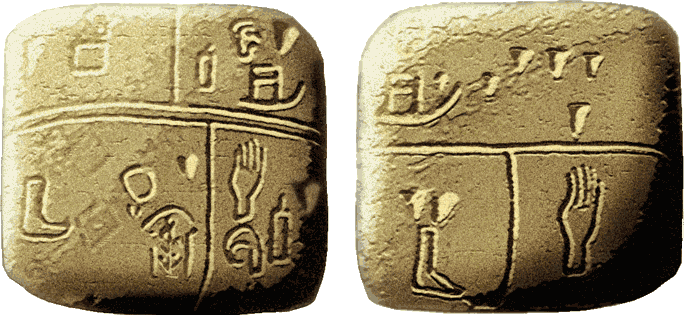
That night, the wind from the desert stirred dust over the ruins of Tell al-Uhaymir. The 1920s. An English archaeologist pulled out from layer 17 of the soil a small object — smooth, heavy, grayish-white like an ancient tooth buried too long. No carved name of a king. No prayer for the god Enlil. No signs of power or glory. Only images: a bull, a mountain, a circle, and three curved lines like a smile that was never spoken.
They named it the Kish tablet — not because it tells about Kish, but because it was found there: the first city in history to bear the title lugal — 'king' — a title that would change the way humans ruled, fought, and remembered themselves.
But this tablet is not a historical record. It is not a list of agricultural produce. It is not a love letter or a war threat. It is the first voice of humanity lost along the way — a voice that reached us, but has never reached anyone's ears since 5,200 years ago.
Where the World Had No Words
Imagine a world without letters. Without an alphabet. Without sounds set for each sign. In the Late Uruk period — between 3200–3000 BCE — people in the valleys of the Tigris and Euphrates rivers stood on the edge of a great chasm: they had already created symbols, but had not yet found a
consensus. Each image on this tablet — a bull, a circle, three curves — might mean 'grain', 'sky', or 'three harvests'. Or it might be a name. Or a spell. Or the name of a forgotten god even by the gods themselves. There is no context, no parallel, no 'Rosetta Stone' accompanying this tablet. It stands alone — like a fossil of a voice that had not yet evolved into language.
The Tablet Found — But Not Understood
Its origin is clear: found in Kish, the legendary city where the first Sumerian king, Etana, was said to have ascended to the sky with the help of an eagle. But what does its carving mean? No one knows. Experts at the Ashmolean Museum — which holds a plaster cast of this tablet — have compared it with thousands of other proto-cuneiform documents. No match. No consistent pattern to be declared as a 'system'. It is not early cuneiform. Not Egyptian pictographs. Not Indus Valley symbols. It is
before all of them. As if this tablet were the first human attempt to lock thoughts into stone — and they failed. Or perhaps — more surprisingly — they succeeded, but their code simply vanished without a trace.
Why Has It Never Been Read?
Not because of a lack of effort. Since the 1930s, linguists from Germany, Japan, and Iraq have spent decades studying its forms. One group tried to map each symbol into a numerical system based on frequency. Others tested it as a lunar calendar. Some speculated it was a magical note — perhaps a spell to call rain or calm floods. But no hypothesis has been philosophically testable: no other text uses the same symbols with the same meaning. No copy. No second version. It is
unique, like a fingerprint of a civilization that had not fully emerged yet.
Behind the Glass in Baghdad
Today, the origin of this tablet — a 420-gram limestone piece — is kept in Room 47, the Iraq Museum, Baghdad. Under dim lights, behind bulletproof glass, it lies still. No long label. No interactive explanation. Just a short sentence:
“From Kish, Late Uruk Period. ~3100 BCE.” Travelers often pass by it. They do not know that beneath their fingers, at a distance of one meter, lies
the zero point in the history of human literacy — not a successful beginning, but a beginning that was
stopped. The point where humans first wrote — and no one learned to read it again.
Voices Waiting at the Edge of Time
The Kish tablet is not just an artifact. It is a reminder: that history is not a straight line from darkness to light. It is a jungle — full of broken branches, dry rivers before reaching the sea, and voices whispering in a language only they understand. Perhaps one day, with AI capable of comparing 50,000 ancient symbols in a second, or with new archives discovered under Nineveh, the key will be found. Or perhaps — and this is more thought-provoking — we will realize that some voices were
never meant to be read. That it was written not to be known, but to be
respected as a mystery. As a sign that before humans learned to tell stories, they first learned to pray in silence — and this tablet is the oldest prayer in the world.
---
Reference: Kish tablet — Wikipedia
This Tablet Was Carved 5,200 Years Ago — But No One Can Read What Is Etched. In a basement warehouse in Baghdad, a small limestone tablet the size of a hand is stored — older than the pyramids of Giza, older than ancient Egyptian writing, and older than any text ever read by humans so far. It is not a fictional secret. It is real. And it remains silent — since the time when gods still spoke through lightning.. That night, the wind from the desert stirred dust over the ruins of Tell al-Uhaymir. The 1920s. An English archaeologist pulled out from layer 17 of the soil a small object — smooth, heavy, grayish-white like an ancient tooth buried too long. No carved name of a king. No prayer for the god Enlil. No signs of power or glory. Only images: a bull, a mountain, a circle, and three curved lines like a smile that was never spoken.
They named it the Kish tablet — not because it tells about Kish, but because it was found there: the first city in history to bear the title lugal — 'king' — a title that would change the way humans ruled, fought, and remembered themselves.
But this tablet is not a historical record. It is not a list of agricultural produce. It is not a love letter or a war threat. It is the first voice of humanity lost along the way — a voice that reached us, but has never reached anyone's ears since 5,200 years ago.
Where the World Had No Words
Imagine a world without letters. Without an alphabet. Without sounds set for each sign. In the Late Uruk period — between 3200–3000 BCE — people in the valleys of the Tigris and Euphrates rivers stood on the edge of a great chasm: they had already created symbols, but had not yet found a consensus . Each image on this tablet — a bull, a circle, three curves — might mean 'grain', 'sky', or 'three harvests'. Or it might be a name. Or a spell. Or the name of a forgotten god even by the gods themselves. There is no context, no parallel, no 'Rosetta Stone' accompanying this tablet. It stands alone — like a fossil of a voice that had not yet evolved into language.
The Tablet Found — But Not Understood
Its origin is clear: found in Kish, the legendary city where the first Sumerian king, Etana, was said to have ascended to the sky with the help of an eagle. But what does its carving mean? No one knows. Experts at the Ashmolean Museum — which holds a plaster cast of this tablet — have compared it with thousands of other proto-cuneiform documents. No match. No consistent pattern to be declared as a 'system'. It is not early cuneiform. Not Egyptian pictographs. Not Indus Valley symbols. It is before all of them . As if this tablet were the first human attempt to lock thoughts into stone — and they failed. Or perhaps — more surprisingly — they succeeded, but their code simply vanished without a trace.
Why Has It Never Been Read?
Not because of a lack of effort. Since the 1930s, linguists from Germany, Japan, and Iraq have spent decades studying its forms. One group tried to map each symbol into a numerical system based on frequency. Others tested it as a lunar calendar. Some speculated it was a magical note — perhaps a spell to call rain or calm floods. But no hypothesis has been philosophically testable: no other text uses the same symbols with the same meaning. No copy. No second version. It is unique , like a fingerprint of a civilization that had not fully emerged yet.
Behind the Glass in Baghdad
Today, the origin of this tablet — a 420-gram limestone piece — is kept in Room 47, the Iraq Museum, Baghdad. Under dim lights, behind bulletproof glass, it lies still. No long label. No interactive explanation. Just a short sentence: “From Kish, Late Uruk Period. 3100 BCE.” Travelers often pass by it. They do not know that beneath their fingers, at a distance of one meter, lies the zero point in the history of human literacy — not a successful beginning, but a beginning that was stopped . The point where humans first wrote — and no one learned to read it again.
Voices Waiting at the Edge of Time
The Kish tablet is not just an artifact. It is a reminder: that history is not a straight line from darkness to light. It is a jungle — full of broken branches, dry rivers before reaching the sea, and voices whispering in a language only they understand. Perhaps one day, with AI capable of comparing 50,000 ancient symbols in a second, or with new archives discovered under Nineveh, the key will be found. Or perhaps — and this is more thought-provoking — we will realize that some voices were never meant to be read . That it was written not to be known, but to be respected as a mystery . As a sign that before humans learned to tell stories, they first learned to pray in silence — and this tablet is the oldest prayer in the world.
---
Reference: Kish tablet — Wikipedia https://en.wikipedia.org/wiki/Kish tablet