Light in the Darkness: Bioluminescence of Deep-Sea Fish
Imagine swimming at a depth of 1,000 meters below the ocean surface. It's pitch black, the water pressure is enough to crush a regular submarine, and the temperature is almost freezing. But suddenly, you see flickering blue-green lights around you. That's the world of deep-sea fish, and their biggest secret is bioluminescence — the ability to produce their own light.
Fish like lanternfish, the most common deep-sea fish in the world, use this light to attract prey, communicate with mates, or confuse predators. This natural flashlight comes from special organs called photophores, which contain light-producing bacteria or chemical reactions in their bodies. Interestingly, each species has a unique light pattern, like a fingerprint! So, if you're a deep-sea fish, you can 'talk' using light without needing to make a sound.
But not all light is friendly. Some fish, like the viperfish, use a glowing lure on the end of their fin to attract unsuspecting prey. The light looks like a small prey, but when the prey gets close, a mouth full of sharp teeth suddenly opens wide. Scary, right? But that's life in the mesopelagic zone (200–1,000 meters), where some sunlight still exists, but just enough to witness terrifying predator-prey dramas.
Dead Zone: Where Oxygen Almost Doesn't Exist
One of the most mysterious places in the ocean is the oxygen minimum layer, located between 700 and 1,000 meters. Here, the oxygen level is so low that most animals would suffocate. However, deep-sea fish like bristlemouths — the species that may be the most numerous on Earth, with trillions of individuals — have adapted in extraordinary ways.
They have super-efficient hemoglobin that can bind oxygen even at very low concentrations. In fact, some species can survive with a very slow metabolism, like hibernation but all the time. This zone is also rich in nutrients, making it an important feeding area. But if you're not a tough deep-sea fish, better not to stop here.
Interestingly, it's in this zone that you'll find the cookiecutter shark — a small shark that bites out "cookies" from the flesh of whales, submarines, or careless divers. Its bite is tight, like cut with a cookie cutter. Scary, but creative, right?
From Darkness to the Bottom: Fish That Live in the Abyssal Zone
When we go deeper, into the bathypelagic zone (1–4 km) and abyssopelagic zone (4–6 km), we enter a completely dark world — no direct sunlight. The temperature is only a few degrees Celsius, and the water pressure is enough to crush a regular submarine. Yet, fish like the famous female anglerfish, known for the "fishing lure" on its head, and the "viperfish" with teeth longer than the size of its mouth, live here.
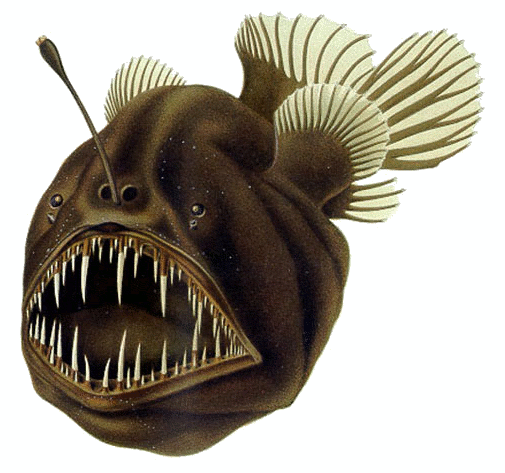
The female anglerfish is a cunning predator. She uses a glowing lure on the end of her fin to attract prey in the dark. When the prey gets close, she opens her large mouth and sucks them in along with the water. What's peculiar is that the male anglerfish is much smaller and attaches itself to the female's body as a parasite — he contributes sperm, but he also depends on the female for food. Romantic? Not really, but practical.
Fish Without Oxygen? Maybe That's Not a Myth
Did you know that there are deep-sea fish that can live without oxygen for long periods? One example is a fish from the eelpout family, living in deep ocean trenches. They have special enzymes that allow them to survive in anoxic (oxygen-free) conditions by switching their metabolism to processes that don't require oxygen.
This is important because at certain depths, oxygen is extremely rare. Imagine if humans could live without breathing for days — that's what these deep-sea fish do. This adaptation is the result of millions of years of evolution, making them among the toughest creatures on the planet.
The Biggest Secret: 98% of Marine Species Are Still Unknown
Although we already know a lot about deep-sea fish, scientists estimate that only 2% of known marine species live in the deep pelagic zone. This means the remaining 98% are still a mystery. Every time a deep-sea expedition is conducted, scientists often discover new species — some glow, some are transparent, and some have jaws that can open like snakes.
For example, recently, researchers discovered a snailfish in the Mariana Trench at a depth of more than 8,000 meters — the deepest recorded fish. This fish looks like a giant tadpole, but it can survive the pressure strong enough to crush steel. Imagine how amazing their adaptations are!
So, when you look at the calm sea on the surface, remember that beneath, thousands of meters down, there is a dark, cold, and mysterious world filled with strange creatures that we still don't fully understand. Perhaps one day, we will find a fish that glows in seven colors, or a fish that can communicate through light pulses. Who knows? The deep sea is an endless gift of mystery to explore.
Reference: Deep-sea fish — Wikipedia
This Deep-Sea Fish Glows in the Dark — And Its Secret Is Stranger Than You Think. Beneath the sunlit surface of the ocean, there is a dark world inhabited by strange creatures such as glowing fish, sharp-toothed predators, and fish that can live without oxygen. Only 2% of known marine species live in the deep pelagic zone, and they have extraordinary adaptations to survive in high pressure and eternal darkness. This article will reveal the secrets of deep-sea fish that may leave you amazed.. Light in the Darkness: Bioluminescence of Deep-Sea Fish
Imagine swimming at a depth of 1,000 meters below the ocean surface. It's pitch black, the water pressure is enough to crush a regular submarine, and the temperature is almost freezing. But suddenly, you see flickering blue-green lights around you. That's the world of deep-sea fish, and their biggest secret is bioluminescence — the ability to produce their own light.
Fish like lanternfish, the most common deep-sea fish in the world, use this light to attract prey, communicate with mates, or confuse predators. This natural flashlight comes from special organs called photophores, which contain light-producing bacteria or chemical reactions in their bodies. Interestingly, each species has a unique light pattern, like a fingerprint! So, if you're a deep-sea fish, you can 'talk' using light without needing to make a sound.
But not all light is friendly. Some fish, like the viperfish, use a glowing lure on the end of their fin to attract unsuspecting prey. The light looks like a small prey, but when the prey gets close, a mouth full of sharp teeth suddenly opens wide. Scary, right? But that's life in the mesopelagic zone 200–1,000 meters , where some sunlight still exists, but just enough to witness terrifying predator-prey dramas.
Dead Zone: Where Oxygen Almost Doesn't Exist
One of the most mysterious places in the ocean is the oxygen minimum layer, located between 700 and 1,000 meters. Here, the oxygen level is so low that most animals would suffocate. However, deep-sea fish like bristlemouths — the species that may be the most numerous on Earth, with trillions of individuals — have adapted in extraordinary ways.
They have super-efficient hemoglobin that can bind oxygen even at very low concentrations. In fact, some species can survive with a very slow metabolism, like hibernation but all the time. This zone is also rich in nutrients, making it an important feeding area. But if you're not a tough deep-sea fish, better not to stop here.
Interestingly, it's in this zone that you'll find the cookiecutter shark — a small shark that bites out "cookies" from the flesh of whales, submarines, or careless divers. Its bite is tight, like cut with a cookie cutter. Scary, but creative, right?
From Darkness to the Bottom: Fish That Live in the Abyssal Zone
When we go deeper, into the bathypelagic zone 1–4 km and abyssopelagic zone 4–6 km , we enter a completely dark world — no direct sunlight. The temperature is only a few degrees Celsius, and the water pressure is enough to crush a regular submarine. Yet, fish like the famous female anglerfish, known for the "fishing lure" on its head, and the "viperfish" with teeth longer than the size of its mouth, live here.
The female anglerfish is a cunning predator. She uses a glowing lure on the end of her fin to attract prey in the dark. When the prey gets close, she opens her large mouth and sucks them in along with the water. What's peculiar is that the male anglerfish is much smaller and attaches itself to the female's body as a parasite — he contributes sperm, but he also depends on the female for food. Romantic? Not really, but practical.
Fish Without Oxygen? Maybe That's Not a Myth
Did you know that there are deep-sea fish that can live without oxygen for long periods? One example is a fish from the eelpout family, living in deep ocean trenches. They have special enzymes that allow them to survive in anoxic oxygen-free conditions by switching their metabolism to processes that don't require oxygen.
This is important because at certain depths, oxygen is extremely rare. Imagine if humans could live without breathing for days — that's what these deep-sea fish do. This adaptation is the result of millions of years of evolution, making them among the toughest creatures on the planet.
The Biggest Secret: 98% of Marine Species Are Still Unknown
Although we already know a lot about deep-sea fish, scientists estimate that only 2% of known marine species live in the deep pelagic zone. This means the remaining 98% are still a mystery. Every time a deep-sea expedition is conducted, scientists often discover new species — some glow, some are transparent, and some have jaws that can open like snakes.
For example, recently, researchers discovered a snailfish in the Mariana Trench at a depth of more than 8,000 meters — the deepest recorded fish. This fish looks like a giant tadpole, but it can survive the pressure strong enough to crush steel. Imagine how amazing their adaptations are!
So, when you look at the calm sea on the surface, remember that beneath, thousands of meters down, there is a dark, cold, and mysterious world filled with strange creatures that we still don't fully understand. Perhaps one day, we will find a fish that glows in seven colors, or a fish that can communicate through light pulses. Who knows? The deep sea is an endless gift of mystery to explore.
Reference: Deep-sea fish — Wikipedia https://en.wikipedia.org/wiki/Deep-sea fish