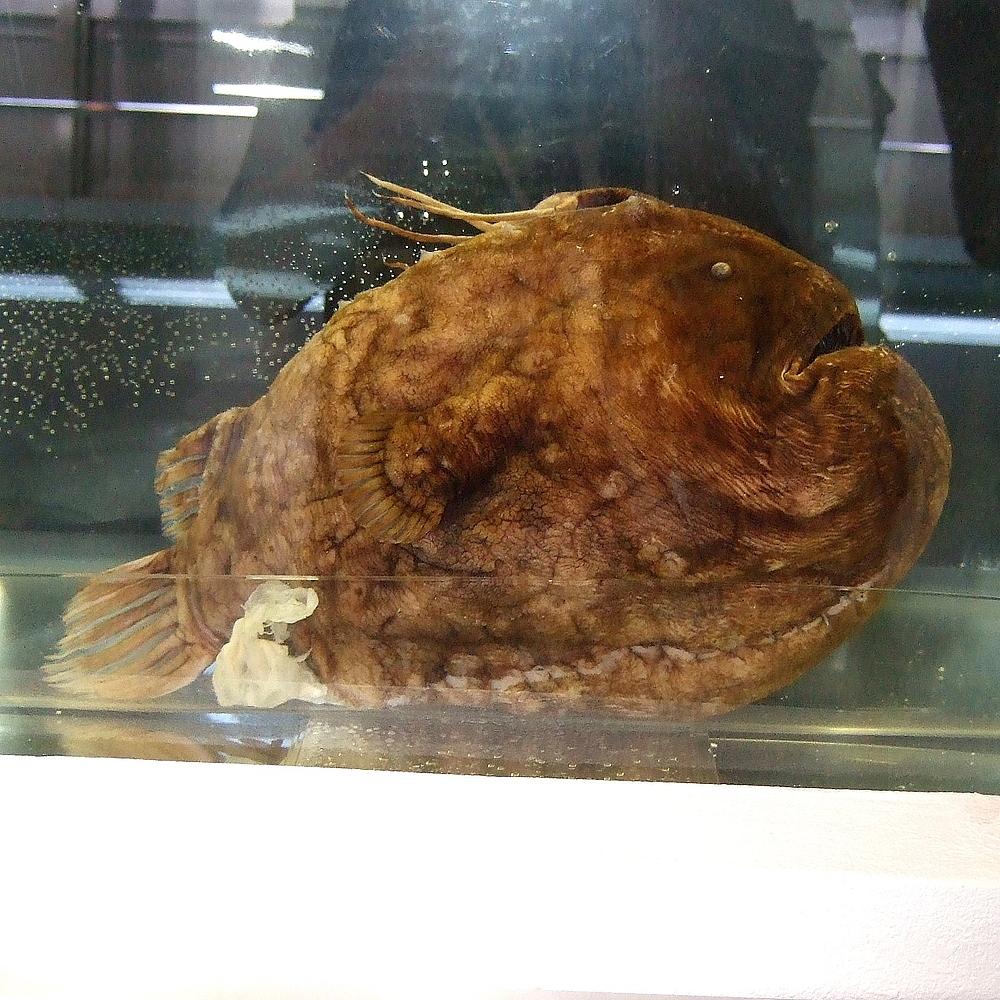
Imagine: you are in a small submarine, with dim headlights piercing the thick darkness. On the sonar screen, a small dot moves slowly—not a regular fish, not a jellyfish, not an octopus. It stops. Then it turns. Then it vanishes into the dark, lightless water. When the crew finally pulls it onto the deck, they are stunned. The creature looks like a sea doll crafted by a dark dream: a large glowing head, a wide mouth filled with crystal teeth, and on its forehead—a small 'light' still flickering, as if just extinguishing its glow.
That is Himantolophus groenlandicus—the Atlantic footballfish. Not just an odd fish. It is one of the most mysterious creatures in the deep ocean—not because it is hard to find, but because it has never been found where it should be.
Head Like a Ball, Body Like a Secret
Its scientific name comes from Greek:
himantos (rope),
lophos (crest), and
groenlandicus (Greenland). Yet ironically, this species is rarely found in Greenland waters. Instead, it dominates the mesopelagic zone—between 500 and 1,200 meters below the surface—where pressure reaches 120 atmospheres, temperature remains stable at 4°C, and absolute darkness rules everything. Its body is round, hard, and covered with fine, spiky scales like dried dragon fruit skin. Its head is larger than its body—not to swallow prey, but to
house a bioluminescent organ called
esca: a glowing 'bait' hanging on an elastic rod on its forehead, which can be moved like a micro-fishing lure.
But this is what confuses zoologists: H. groenlandicus does not have a swim bladder. It also lacks strong tail muscles for active swimming. So how does it survive at such depths without sinking or rising uncontrollably?
The Secret of Floating Without Movement
A 2021 MRI and histological tissue analysis (published in
Deep-Sea Research Part I) found something surprising: 78% of the fish's body consists of a
special protein gel—not fat, not regular water, but a gelatinous matrix containing a unique glycoprotein called
hydrophilin. This substance absorbs seawater until it reaches the exact same density as the surrounding water. The result? It becomes
neutrally buoyant—floating without effort, like a helium balloon set at a certain altitude. It doesn't swim—it
floats in time. Each small movement is done by moving its pectoral fins like bird wings, not by rowing.
And this explains why it has never been found on the seafloor: it never goes down there. Even when dead, its body does not sink—it slowly rises to the epipelagic zone, where surface currents carry it to the shore. That is why most specimens are found washed ashore, not caught with deep-sea trawls.
The Fading Trail on the Map
The first record of
H. groenlandicus was noted in 1896 in the Norwegian Sea. Since then, for almost 120 years, all records were limited to the North and South Atlantic. But in 2017, a complete specimen was found on the Tamil Nadu coast in India—far beyond expectations. The following year, two more were found on the Chiba coast in Japan. And in 2022, another was found on Easter Island—right in the middle of the South Pacific Ocean.
No fishing records exist between these three locations. No records of warm or cold current transport strong enough to carry a 15–20 kg adult fish across thousands of kilometers. Oceanographers from the University of Hawaii tested larval dispersal models—and found: its larvae cannot survive more than 45 days in surface water. So, how did it appear in three different oceans, without any genetic evidence showing evolutionary separation?
Genetics That Hold Another Story
Mitochondrial sequences from 37 specimens from the Atlantic, India, and the Pacific show
genetic homogeneity exceeding 99.97%. This means the populations in the three regions are not subspecies—but
one global population spread without borders. Further studies confirmed: there are no genetic barriers between them. The only logical explanation? It moves through the
global mesopelagic zone—an interconnected layer of the ocean, like an invisible underwater highway system. Slow but consistent internal currents, such as the
Antarctic Bottom Water and
North Atlantic Deep Water, may carry adult individuals—not by swimming, but by
passive transport within long-term water mass flows.
What Is Lost in the Darkness, Never Truly Disappears
Himantolophus groenlandicus is not just a rare fish. It is a reminder: the ocean is not just a three-dimensional space—it is a
four-dimensional time, where time, pressure, temperature, and currents work together as a living system. It teaches us that 'not found' does not mean 'not there', and 'not moving' does not mean 'not moving'. It floats—and in that delay, it has traveled farther than most creatures on Earth.
And perhaps, as you read this, a H. groenlandicus is stopping in the darkness 800 meters below the Indian Ocean—its light dimmed, its lure rod still, but its eyes—yes, it has eyes—staring toward a light it has never seen, waiting for something that will never come… or waiting for us to finally understand that it does not need to come to us—because we, in fact, have never truly reached it.
---
Reference: Himantolophus groenlandicus — Wikipedia
This Fish Never Touches the Seabed — Yet Has Been Found in Three Different Oceans. At depths of 500–1,200 meters, where sunlight disappears completely, creatures live that have never touched the seafloor—not because they are too high, but because their bodies are designed to *float forever*. It was found in the Atlantic, then suddenly appeared in the Indian and Pacific Oceans—without any trace of migration. How can a species 'disappear' from the biogeographic map for decades… only to reappear in an impossible place?. Imagine: you are in a small submarine, with dim headlights piercing the thick darkness. On the sonar screen, a small dot moves slowly—not a regular fish, not a jellyfish, not an octopus. It stops. Then it turns. Then it vanishes into the dark, lightless water. When the crew finally pulls it onto the deck, they are stunned. The creature looks like a sea doll crafted by a dark dream: a large glowing head, a wide mouth filled with crystal teeth, and on its forehead—a small 'light' still flickering, as if just extinguishing its glow.
That is Himantolophus groenlandicus —the Atlantic footballfish. Not just an odd fish. It is one of the most mysterious creatures in the deep ocean—not because it is hard to find, but because it has never been found where it should be .
Head Like a Ball, Body Like a Secret
Its scientific name comes from Greek: himantos rope , lophos crest , and groenlandicus Greenland . Yet ironically, this species is rarely found in Greenland waters. Instead, it dominates the mesopelagic zone—between 500 and 1,200 meters below the surface—where pressure reaches 120 atmospheres, temperature remains stable at 4°C, and absolute darkness rules everything. Its body is round, hard, and covered with fine, spiky scales like dried dragon fruit skin. Its head is larger than its body—not to swallow prey, but to house a bioluminescent organ called esca : a glowing 'bait' hanging on an elastic rod on its forehead, which can be moved like a micro-fishing lure.
But this is what confuses zoologists: H. groenlandicus does not have a swim bladder. It also lacks strong tail muscles for active swimming. So how does it survive at such depths without sinking or rising uncontrollably?
The Secret of Floating Without Movement
A 2021 MRI and histological tissue analysis published in Deep-Sea Research Part I found something surprising: 78% of the fish's body consists of a special protein gel —not fat, not regular water, but a gelatinous matrix containing a unique glycoprotein called hydrophilin . This substance absorbs seawater until it reaches the exact same density as the surrounding water. The result? It becomes neutrally buoyant —floating without effort, like a helium balloon set at a certain altitude. It doesn't swim—it floats in time . Each small movement is done by moving its pectoral fins like bird wings, not by rowing.
And this explains why it has never been found on the seafloor: it never goes down there . Even when dead, its body does not sink—it slowly rises to the epipelagic zone, where surface currents carry it to the shore. That is why most specimens are found washed ashore , not caught with deep-sea trawls.
The Fading Trail on the Map
The first record of H. groenlandicus was noted in 1896 in the Norwegian Sea. Since then, for almost 120 years, all records were limited to the North and South Atlantic. But in 2017, a complete specimen was found on the Tamil Nadu coast in India—far beyond expectations. The following year, two more were found on the Chiba coast in Japan. And in 2022, another was found on Easter Island—right in the middle of the South Pacific Ocean.
No fishing records exist between these three locations. No records of warm or cold current transport strong enough to carry a 15–20 kg adult fish across thousands of kilometers. Oceanographers from the University of Hawaii tested larval dispersal models—and found: its larvae cannot survive more than 45 days in surface water . So, how did it appear in three different oceans, without any genetic evidence showing evolutionary separation?
Genetics That Hold Another Story
Mitochondrial sequences from 37 specimens from the Atlantic, India, and the Pacific show genetic homogeneity exceeding 99.97% . This means the populations in the three regions are not subspecies—but one global population spread without borders . Further studies confirmed: there are no genetic barriers between them. The only logical explanation? It moves through the global mesopelagic zone —an interconnected layer of the ocean, like an invisible underwater highway system. Slow but consistent internal currents, such as the Antarctic Bottom Water and North Atlantic Deep Water , may carry adult individuals—not by swimming, but by passive transport within long-term water mass flows.
What Is Lost in the Darkness, Never Truly Disappears
Himantolophus groenlandicus is not just a rare fish. It is a reminder: the ocean is not just a three-dimensional space—it is a four-dimensional time , where time, pressure, temperature, and currents work together as a living system. It teaches us that 'not found' does not mean 'not there', and 'not moving' does not mean 'not moving'. It floats—and in that delay, it has traveled farther than most creatures on Earth.
And perhaps, as you read this, a H. groenlandicus is stopping in the darkness 800 meters below the Indian Ocean—its light dimmed, its lure rod still, but its eyes—yes, it has eyes—staring toward a light it has never seen, waiting for something that will never come… or waiting for us to finally understand that it does not need to come to us—because we, in fact, have never truly reached it.
---
Reference: Himantolophus groenlandicus — Wikipedia https://en.wikipedia.org/wiki/Himantolophus groenlandicus