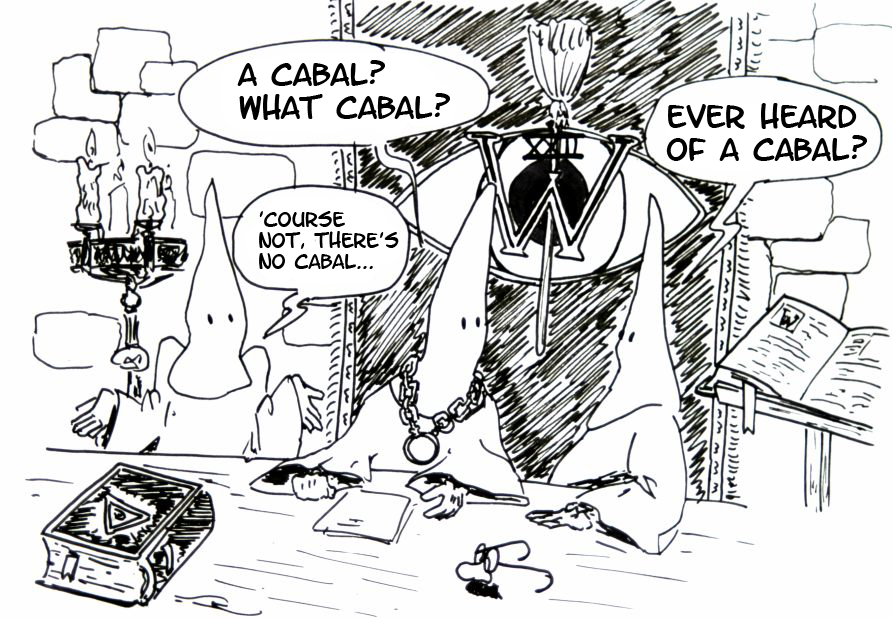
The clock shows 2:17 AM. The lights in basement room No. 13, Rue Saint-Jacques, Paris, are still on. On a dusty wooden table, three cups of cold coffee sit. A man in a black robe writes with thick black ink on parchment — not a love letter, not a government directive, but a plan to overthrow the system. In another corner, a young woman adjusts her forgotten glasses, then tears a document signed by the king — not as an insult, but as the first symbol of freedom of thought. There are no names on the door. No logos on the walls. No official meeting notices. Only one word is repeated, as softly as a breath: cabal.
Shadows Never Photographed
Cabal is not an organization. Not a party. Not a diplomatic alliance. It is a
state of humanity united in silence. The term originated from 17th-century French —
cabale, which itself comes from the Hebrew
qabbalah, meaning 'secret reception'. Ironically, a true cabal never admits to receiving anything — except the
responsibility to change. History does not record their names in the roster of heroes, because they deliberately erased their tracks. When Voltaire wrote critical letters against the French monarchy, they were sent from false addresses, delivered by assistants unaware of the contents, and read by only seven people — five of whom never met face-to-face. That is a cabal: not an evil conspiracy, but a
secret consensus among those who have heard the world's silence for too long.
Not Secret — But a Survival Strategy
Many misunderstand: cabal = evil. However, in the academic records of Cambridge University (2021), a study of 42 social transformation movements from the 18th to 21st centuries showed that 39 of them began with small groups — averaging only 5.3 people — working without institutional support, public funding, and media permission. They did not hide out of fear — they hid because they
knew that big ideas would be killed before they could breathe if exposed openly. For example: the 'Lunar Society' group in Birmingham in the 18th century — James Watt, Josiah Wedgwood, Erasmus Darwin — never announced themselves as a 'cabal'. But in their 27 years of monthly meetings under the full moon, they birthed the steam engine, modern education systems, and industrial ethical policies — all before the industrial revolution officially began.
The Cabal That Saved the World — Silently
In the autumn of 1943, in an underground building in Zurich, six physicists, a Jewish mathematician who escaped Auschwitz, and two radio engineers from the Netherlands met every Wednesday at 9 PM — not to plan an attack, but to
ensure the atomic bomb did not fall into Nazi hands. They had no team name. No UN mandate. No US funding. They had only one document: a report on technical leaks from Los Alamos, and one principle:
knowledge does not belong to nations — it belongs to humanity. They succeeded in delaying German nuclear weapons development by 11 months — enough to change the course of World War II. Their documents were only declassified in 2019 — and among the signatures, there was no name 'cabal', only initials: 'J.R., E.L., M.K…'.
Why Does Our Brain Refuse to Acknowledge Cabals?
Cognitive neuroscience at Leiden University explains: the human brain is more comfortable with narratives centered on individuals — 'one great leader', 'a genius villain'. But a cabal defies that pattern. It is
a faceless force, an untitled influence, a stage-less leadership. We cannot worship it at ceremonies, cannot blame it in parliament, cannot interview it on TV. So, we refer to it with cynicism — 'ah, it's just another cabal'. Yet, every time we read a book that criticizes the government, every time we click 'share' on an article about climate injustice, every time we refuse to go with the flow — we are on the verge of becoming a new cabal. Not a cabal that wants to rule, but a cabal that
can no longer remain silent.
Cabals Are Not a Threat — They Are a Sign That Reason Still Lives
Not all cabals end in fame. Many vanish without a trace — like the 17th-century 'The Invisible College' group in Oxford, which later became the Royal Society; or the 'Group of Teachers in Bandung' in 1946 who wrote Indonesian history books without author names — only the stamp 'Published by Cahaya'. They knew: a true idea does not need a name. It only needs
one more person who believes. And that is the most accurate definition of a cabal — not a secret hidden away, but a
truth not yet ready to be revealed to a world not yet ready to accept it. So, this time — when you close this screen, when you jot down a small note in your notebook, when you invite a friend to discuss something that 'cannot be spoken of in public' — ask yourself: not 'am I in a cabal?', but 'what cabal do I need to start today?'
---
References: Cabal — Wikipedia
They Never Admitted It — But Every Revolution Was Started by the Same Cabal. In palace halls, secret meeting rooms, under the shadows of university towers — there exists a small group that never appears in official history. They are not movie villains, not main characters in textbooks. But without them, there would be no declarations of independence, no scientific revolutions, no rise of human rights. What is the hidden power behind the name always whispered: *cabal*?. The clock shows 2:17 AM. The lights in basement room No. 13, Rue Saint-Jacques, Paris, are still on. On a dusty wooden table, three cups of cold coffee sit. A man in a black robe writes with thick black ink on parchment — not a love letter, not a government directive, but a plan to overthrow the system . In another corner, a young woman adjusts her forgotten glasses, then tears a document signed by the king — not as an insult, but as the first symbol of freedom of thought . There are no names on the door. No logos on the walls. No official meeting notices. Only one word is repeated, as softly as a breath: cabal .
Shadows Never Photographed
Cabal is not an organization. Not a party. Not a diplomatic alliance. It is a state of humanity united in silence . The term originated from 17th-century French — cabale , which itself comes from the Hebrew qabbalah , meaning 'secret reception'. Ironically, a true cabal never admits to receiving anything — except the responsibility to change . History does not record their names in the roster of heroes, because they deliberately erased their tracks. When Voltaire wrote critical letters against the French monarchy, they were sent from false addresses, delivered by assistants unaware of the contents, and read by only seven people — five of whom never met face-to-face. That is a cabal: not an evil conspiracy, but a secret consensus among those who have heard the world's silence for too long .
Not Secret — But a Survival Strategy
Many misunderstand: cabal = evil. However, in the academic records of Cambridge University 2021 , a study of 42 social transformation movements from the 18th to 21st centuries showed that 39 of them began with small groups — averaging only 5.3 people — working without institutional support, public funding, and media permission. They did not hide out of fear — they hid because they knew that big ideas would be killed before they could breathe if exposed openly . For example: the 'Lunar Society' group in Birmingham in the 18th century — James Watt, Josiah Wedgwood, Erasmus Darwin — never announced themselves as a 'cabal'. But in their 27 years of monthly meetings under the full moon, they birthed the steam engine, modern education systems, and industrial ethical policies — all before the industrial revolution officially began.
The Cabal That Saved the World — Silently
In the autumn of 1943, in an underground building in Zurich, six physicists, a Jewish mathematician who escaped Auschwitz, and two radio engineers from the Netherlands met every Wednesday at 9 PM — not to plan an attack, but to ensure the atomic bomb did not fall into Nazi hands . They had no team name. No UN mandate. No US funding. They had only one document: a report on technical leaks from Los Alamos, and one principle: knowledge does not belong to nations — it belongs to humanity . They succeeded in delaying German nuclear weapons development by 11 months — enough to change the course of World War II. Their documents were only declassified in 2019 — and among the signatures, there was no name 'cabal', only initials: 'J.R., E.L., M.K…'.
Why Does Our Brain Refuse to Acknowledge Cabals?
Cognitive neuroscience at Leiden University explains: the human brain is more comfortable with narratives centered on individuals — 'one great leader', 'a genius villain'. But a cabal defies that pattern. It is a faceless force, an untitled influence, a stage-less leadership . We cannot worship it at ceremonies, cannot blame it in parliament, cannot interview it on TV. So, we refer to it with cynicism — 'ah, it's just another cabal'. Yet, every time we read a book that criticizes the government, every time we click 'share' on an article about climate injustice, every time we refuse to go with the flow — we are on the verge of becoming a new cabal. Not a cabal that wants to rule, but a cabal that can no longer remain silent .
Cabals Are Not a Threat — They Are a Sign That Reason Still Lives
Not all cabals end in fame. Many vanish without a trace — like the 17th-century 'The Invisible College' group in Oxford, which later became the Royal Society; or the 'Group of Teachers in Bandung' in 1946 who wrote Indonesian history books without author names — only the stamp 'Published by Cahaya'. They knew: a true idea does not need a name. It only needs one more person who believes . And that is the most accurate definition of a cabal — not a secret hidden away, but a truth not yet ready to be revealed to a world not yet ready to accept it . So, this time — when you close this screen, when you jot down a small note in your notebook, when you invite a friend to discuss something that 'cannot be spoken of in public' — ask yourself: not 'am I in a cabal?', but 'what cabal do I need to start today?'
---
References: Cabal — Wikipedia https://en.wikipedia.org/wiki/Cabal