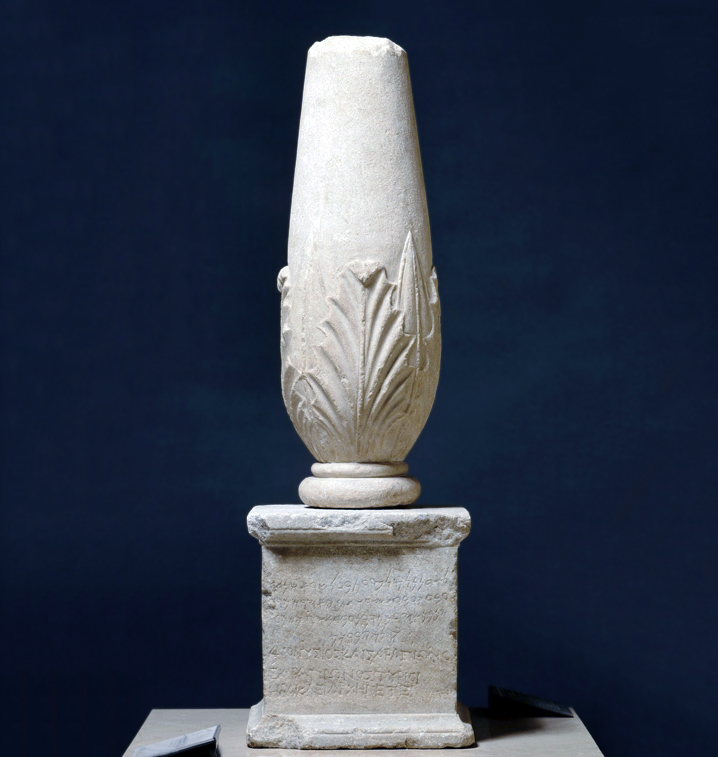
What is the Limyra Bilingual Inscription — and why is it not supposed to be moved?
The Limyra Bilingual Inscription is not just a written stone — it is an archaeological document
still in its original location. Found in 1840 by European travelers in the Limyra Necropolis (now in the Antalya province of south-western Turkey), this inscription is permanently carved into the entrance of Tomb No. 46 — a classic Lycian rock-cut tomb, dug directly from a limestone cliff. What makes it unique: it has never been moved, never subjected to invasive restoration, and stands
in situ, exactly as it was made around 350 BCE. This makes it one of the most authentic examples in the world for studying language, power, and identity interactions in Asia Minor during the Achaemenid period — when the Persian Empire ruled the region, but Greek culture and Lycian traditions continued to coexist.
Why two languages — Greek and Aramaic — appear on one tomb, not three or one?
In the 4th century BCE, Aramaic was the official administrative language of the Achaemenid Empire — the 'diplomatic language' from Mesopotamia to Anatolia. Greek, meanwhile, was rising as the language of trade, education, and elite coastal cities like Limyra. However, the presence of
both on a funerary monument — not in a palace or official stele, but in a
private tomb — suggests something more subtle: a statement of dual identity. The tomb's owner (whose full name is unknown, only referred to as 'son of Padas') wanted to be recognized not only as a Lycian citizen, but also as an individual operating in two worlds — the Persian bureaucratic system (through Aramaic) and the Greek cultural-maritime network (through Greek). There is no other tomb in Limyra that does this. None have both. None have followed suit.
Where exactly is the text carved — and why is its location intentionally meaningful?
The Aramaic text (known in epigraphic literature as KAI 262 —
Kanaanäische und Aramäische Inschriften) is carved on the
lintel (door threshold) of the left door — a low, personal position, visible only when standing close. In contrast, the Greek text is carved on the
frieze — a horizontal band above both doors — high, open, and readable from a distance. This is not a technical coincidence. It is a symbolic architecture: Aramaic as internal identity, family secret, or connection with the central power; Greek as external identity, for the public, sailors, merchants, and visitors to the tomb. The carving of two languages at these two visual levels proves that language is not just a means of communication — but a social hierarchy etched in stone.
Why did the first analysis only emerge 47 years after its discovery — and what remains unsolved?
Although discovered in 1840, this inscription was only systematically analyzed by German orientalist Eduard Sachau in 1887 — in his work
Reise in Syrien und Mesopotamien. Why so late? Because ancient Aramaic is very difficult to read without parallel context, and at the time, only a few Aramaic inscriptions from Anatolia were known. Sachau used comparisons with inscriptions from Sardis and Babylon to decipher its sentence structure. However, even today, one phrase in the Aramaic text — ‘
bḥr ḥy’ — remains debated: does it mean 'before life' (as an eschatological expression), or 'before the living' (referring to a god or king)? No consensus exists. No sufficiently clear parallel texts. It remains an
open linguistic gap — like a small crack between two coexisting languages, but never fully united.
What are the real implications for Malaysian history — and why should we care?
You may ask: 'What does this have to do with us?' The answer lies in how we understand multilingualism not as a 'problem', but as a
strategy for existence. In Limyra, bilingualism was not a sign of lost identity — rather, it was evidence of cultural agility, the ability to negotiate between empires and local roots, between central power and local autonomy. Today in Malaysia, we live in a similar reality: Malay as the constitutional core, English as the gateway to global knowledge, mother tongue as the soul of the family — not conflict, but layers of meaning that enrich each other. The Limyra tomb reminds us: when two languages meet on stone for 2,400 years, they do not seek to erase each other — but to protect meaning from being lost.
Why has this tomb never been replicated — and what does it say about human uniqueness?
Among more than 150 tombs in the Limyra Necropolis, only one chose bilingualism. There are no copies, no imitations, no subsequent generations that repeated it. This is not a technical limitation — but a very specific, perhaps even individual, cultural decision. It shows that multilingualism is not an automatic trend — it is a bold choice, the result of deep reflection on who we are, where we stand, and for whom we want to be known — even after death. And that is why, 2,400 years later, we still stand before the tomb's door, looking up and down, searching for answers — not just in Greek or Aramaic, but in the silence between them.
---
Reference: Limyra bilingual inscription — Wikipedia
Why This 4th-Century BCE Tomb Contains TWO Languages — But Only One Tomb in All of Limyra?. Amidst the ancient necropolis in south-west Turkey, a stone tomb has remained untouched for 2,400 years — and the only one there that speaks in two languages at once. Why only this tomb? Who ordered the Aramaic and Greek inscriptions to coexist? And why do experts still debate its final meaning — even though the text is intact?. What is the Limyra Bilingual Inscription — and why is it not supposed to be moved ?
The Limyra Bilingual Inscription is not just a written stone — it is an archaeological document still in its original location . Found in 1840 by European travelers in the Limyra Necropolis now in the Antalya province of south-western Turkey , this inscription is permanently carved into the entrance of Tomb No. 46 — a classic Lycian rock-cut tomb, dug directly from a limestone cliff. What makes it unique: it has never been moved, never subjected to invasive restoration, and stands in situ , exactly as it was made around 350 BCE. This makes it one of the most authentic examples in the world for studying language, power, and identity interactions in Asia Minor during the Achaemenid period — when the Persian Empire ruled the region, but Greek culture and Lycian traditions continued to coexist.
Why two languages — Greek and Aramaic — appear on one tomb, not three or one?
In the 4th century BCE, Aramaic was the official administrative language of the Achaemenid Empire — the 'diplomatic language' from Mesopotamia to Anatolia. Greek, meanwhile, was rising as the language of trade, education, and elite coastal cities like Limyra. However, the presence of both on a funerary monument — not in a palace or official stele, but in a private tomb — suggests something more subtle: a statement of dual identity. The tomb's owner whose full name is unknown, only referred to as 'son of Padas' wanted to be recognized not only as a Lycian citizen, but also as an individual operating in two worlds — the Persian bureaucratic system through Aramaic and the Greek cultural-maritime network through Greek . There is no other tomb in Limyra that does this. None have both. None have followed suit.
Where exactly is the text carved — and why is its location intentionally meaningful ?
The Aramaic text known in epigraphic literature as KAI 262 — Kanaanäische und Aramäische Inschriften is carved on the lintel door threshold of the left door — a low, personal position, visible only when standing close. In contrast, the Greek text is carved on the frieze — a horizontal band above both doors — high, open, and readable from a distance. This is not a technical coincidence. It is a symbolic architecture: Aramaic as internal identity, family secret, or connection with the central power; Greek as external identity, for the public, sailors, merchants, and visitors to the tomb. The carving of two languages at these two visual levels proves that language is not just a means of communication — but a social hierarchy etched in stone.
Why did the first analysis only emerge 47 years after its discovery — and what remains unsolved ?
Although discovered in 1840, this inscription was only systematically analyzed by German orientalist Eduard Sachau in 1887 — in his work Reise in Syrien und Mesopotamien . Why so late? Because ancient Aramaic is very difficult to read without parallel context, and at the time, only a few Aramaic inscriptions from Anatolia were known. Sachau used comparisons with inscriptions from Sardis and Babylon to decipher its sentence structure. However, even today, one phrase in the Aramaic text — ‘ bḥr ḥy ’ — remains debated: does it mean 'before life' as an eschatological expression , or 'before the living' referring to a god or king ? No consensus exists. No sufficiently clear parallel texts. It remains an open linguistic gap — like a small crack between two coexisting languages, but never fully united.
What are the real implications for Malaysian history — and why should we care?
You may ask: 'What does this have to do with us?' The answer lies in how we understand multilingualism not as a 'problem', but as a strategy for existence . In Limyra, bilingualism was not a sign of lost identity — rather, it was evidence of cultural agility, the ability to negotiate between empires and local roots, between central power and local autonomy. Today in Malaysia, we live in a similar reality: Malay as the constitutional core, English as the gateway to global knowledge, mother tongue as the soul of the family — not conflict, but layers of meaning that enrich each other. The Limyra tomb reminds us: when two languages meet on stone for 2,400 years, they do not seek to erase each other — but to protect meaning from being lost.
Why has this tomb never been replicated — and what does it say about human uniqueness?
Among more than 150 tombs in the Limyra Necropolis, only one chose bilingualism. There are no copies, no imitations, no subsequent generations that repeated it. This is not a technical limitation — but a very specific, perhaps even individual, cultural decision. It shows that multilingualism is not an automatic trend — it is a bold choice, the result of deep reflection on who we are, where we stand, and for whom we want to be known — even after death. And that is why, 2,400 years later, we still stand before the tomb's door, looking up and down, searching for answers — not just in Greek or Aramaic, but in the silence between them.
---
Reference: Limyra bilingual inscription — Wikipedia https://en.wikipedia.org/wiki/Limyra bilingual inscription