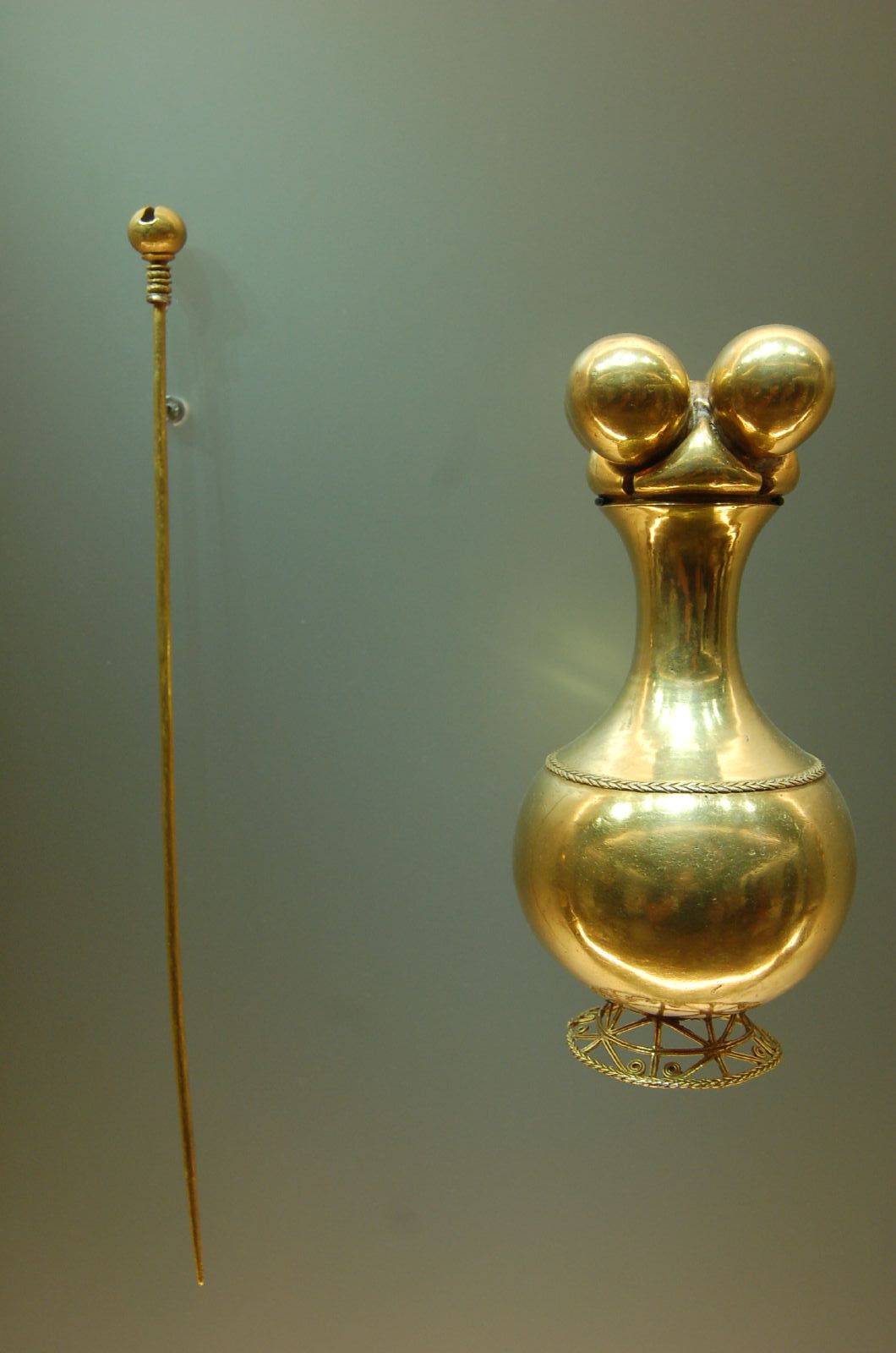
1. Poporo Is Not a Eating Tool — It Is a Connector Between the Real World and the Spiritual World
Many misunderstand: poporo is not a spoon, not a salt container, nor a regular ornament. It is a
three-dimensional connector — between the mouth (where coca leaves are chewed), the hands (which hold the metal or wooden pin), and the soul (which awaits the activation of coca alkaloids through lime). Lime — made from burned and finely ground seashells — is not an additive; it is a
sacred catalyst. Without lime, coca leaves only provide a bitter taste and slight stimulation. With lime, alkaloids like cocaine are slowly released, triggering dopamine release, suppression of hunger, and mental clarity used in prayer, mountain navigation, and community decision-making. To the Wiwa people, each dot of lime raised by the poporo pin is a 'meeting point between earth and sky'. That is why poporo is often carved with symbols of the sun, snakes (guardians of the underworld), and roots — not decoration, but a three-layer cosmological map.
2. Poporo Quimbaya: Gold That Never Melted — and the Confusing Bronze Secret That Fooled Scientists
Poporo Quimbaya — a 1,300-year-old gold artifact in the Bogotá Gold Museum — is not just beautiful. It is a
living metallurgy document. Modern XRF analysis proves it was made from
bronze: a mixture of copper, gold, and a little silver — not pure gold. Surprisingly, this mixture was specifically designed to
withstand high temperatures without cracking, while also facilitating the pouring of hot lime liquid (lime is often heated before being placed into the poporo for sterilization and chemical activation). Even more astonishing: the casting technique was lost for 800 years after the fall of Quimbaya, and was only revived in 2017 by a Colombian gold artist after analyzing 47 micro-engraved layers on the poporo. Each spiral groove on its body is not art — it is a capillary channel that controls the rate of lime release to the pin. No European artifact from the 5th century has such a sophisticated functional design.
3. Totumo: Dried Fruit That Stores Lime Better Than Gold — and Why It Never Decays
In the Sierra Nevada de Santa Marta, modern poporo is made from the fruit
Crescentia cujete — locally known as
totumo. Not just any fruit: its skin contains unique concentrations of lignin and tannins that form a
natural biopolymer layer when dried. Tests at Antioquia University (2021) showed that totumo poporo can store dry lime for
14 months without losing alkalinity, while metal poporo only lasts 5–6 months before the lime carbonates and loses effectiveness. Moreover, totumo is
thermoregulatory: it absorbs heat during the day and releases it slowly at night — keeping the lime at an optimal pH of 11.2–11.8. This is no coincidence: the Kogi people believe totumo 'breathes', and every poporo inherited from ancestors must be filled with lime from the same beach where the original shells were collected — connecting the sea, mountains, and generations in a single chemical-sacred chain.
4. Poporo Pins Are Not Needles — They Are 'Soul Pulse Connectors' Carved Based on Age and Status
The pin on the top of the poporo — often mistakenly seen as a lime scooper — is actually a
personal antenna. Its length, thickness, and head shape vary according to age, gender, and social role: short pins with round heads for beginner teenagers; long pins with sharp tips for
Aluna (spiritual leaders); triple-wound pins for
Siu (sacred mountain keepers). Ethnographic studies by anthropologist Dr. Luz María Gutiérrez (2020) documented that each pin is carved with
pressure from the left index finger — the hand in Kogi cosmology representing 'connection to the root of the earth'. If the pin breaks, it is not replaced — instead, the poporo is buried with its owner, because 'a broken soul cannot be reconnected'. This explains why archaeologists found gold poporo in graves alongside bones — not as treasure, but as a
supplementary organ needed for the afterlife journey.
5. Poporo Is the Only Traditional Tool in the World That Still Uses 'Self-Calibrating Lime Release' Technology
No other traditional tool — from the
quid box of India to the
betel nut container of Thailand — uses a lime delivery mechanism that simultaneously depends on
microgravity,
muscle pressure, and
mouth moisture. When the user chews coca, mouth pressure moves the pin into the lime hole; moisture from saliva causes the lime to slightly adhere to the pin; and microgravity (when the head tilts slightly forward during prayer) allows the lime to fall precisely onto the coca leaf — not the tongue, not the gums, but
onto the leaf surface. This system is so precise that one totumo poporo can be used up to
7,200 chews before the pin runs out — an average of 20 years of daily use. This is not a myth: data collected from 12 Wiwa families between 2015–2023 by the Colombian Ethnobotanical Institute confirm this. And yes — this system has never been replicated in modern pharmaceutical design.
6. Why Did UNESCO Not Recognize Poporo as a World Heritage? The Answer Lies in the Small Hole at the Bottom of Its Lid
In 2019, UNESCO rejected the proposal to protect poporo as a world heritage — not because it had no value, but because
it was too alive to be classified. As stated in their internal note: 'Poporo is not something passed down from the past; it is an ongoing process that knows no time boundaries and resists objectification.' The small hole at the bottom of the poporo lid — where the lime exits — is not an ordinary hole. It is called
‘Xia’ in the Kogi language: 'the point where time stops becoming a line and becomes a circle'. Every time the lime exits from there, the user is not just chewing — they are
recreating the world, as taught in the
Aluna, the oldest oral book in the Americas. That is why there is no 'last poporo'. There are 3,842 active poporo in the Sierra Nevada today — and each one is proof that tradition is not a heritage protected in a vitrine… but a breath still beating.
---
Rujukan: Poporo — Wikipedia
This Thing Has Been Used for 1,200 Years — and Is Still Used Today?. In the remote mountainous region of Colombia, a small, dried fruit-shaped tool has been continuously used since pre-Columbian times. It is not just an artifact — but a bridge between mouth, spirit, and cosmos. How can something made from a dried gourd last longer than kingdoms, temples, and languages? The answer lies in the way the Wiwa and Kogi people chew coca leaves — and why UNESCO once declared poporo as 'the most stable intangible heritage in South America'.. 1. Poporo Is Not a Eating Tool — It Is a Connector Between the Real World and the Spiritual World
Many misunderstand: poporo is not a spoon, not a salt container, nor a regular ornament. It is a three-dimensional connector — between the mouth where coca leaves are chewed , the hands which hold the metal or wooden pin , and the soul which awaits the activation of coca alkaloids through lime . Lime — made from burned and finely ground seashells — is not an additive; it is a sacred catalyst . Without lime, coca leaves only provide a bitter taste and slight stimulation. With lime, alkaloids like cocaine are slowly released, triggering dopamine release, suppression of hunger, and mental clarity used in prayer, mountain navigation, and community decision-making. To the Wiwa people, each dot of lime raised by the poporo pin is a 'meeting point between earth and sky'. That is why poporo is often carved with symbols of the sun, snakes guardians of the underworld , and roots — not decoration, but a three-layer cosmological map.
2. Poporo Quimbaya: Gold That Never Melted — and the Confusing Bronze Secret That Fooled Scientists
Poporo Quimbaya — a 1,300-year-old gold artifact in the Bogotá Gold Museum — is not just beautiful. It is a living metallurgy document . Modern XRF analysis proves it was made from bronze : a mixture of copper, gold, and a little silver — not pure gold. Surprisingly, this mixture was specifically designed to withstand high temperatures without cracking , while also facilitating the pouring of hot lime liquid lime is often heated before being placed into the poporo for sterilization and chemical activation . Even more astonishing: the casting technique was lost for 800 years after the fall of Quimbaya, and was only revived in 2017 by a Colombian gold artist after analyzing 47 micro-engraved layers on the poporo. Each spiral groove on its body is not art — it is a capillary channel that controls the rate of lime release to the pin. No European artifact from the 5th century has such a sophisticated functional design.
3. Totumo: Dried Fruit That Stores Lime Better Than Gold — and Why It Never Decays
In the Sierra Nevada de Santa Marta, modern poporo is made from the fruit Crescentia cujete — locally known as totumo . Not just any fruit: its skin contains unique concentrations of lignin and tannins that form a natural biopolymer layer when dried. Tests at Antioquia University 2021 showed that totumo poporo can store dry lime for 14 months without losing alkalinity , while metal poporo only lasts 5–6 months before the lime carbonates and loses effectiveness. Moreover, totumo is thermoregulatory : it absorbs heat during the day and releases it slowly at night — keeping the lime at an optimal pH of 11.2–11.8. This is no coincidence: the Kogi people believe totumo 'breathes', and every poporo inherited from ancestors must be filled with lime from the same beach where the original shells were collected — connecting the sea, mountains, and generations in a single chemical-sacred chain.
4. Poporo Pins Are Not Needles — They Are 'Soul Pulse Connectors' Carved Based on Age and Status
The pin on the top of the poporo — often mistakenly seen as a lime scooper — is actually a personal antenna . Its length, thickness, and head shape vary according to age, gender, and social role: short pins with round heads for beginner teenagers; long pins with sharp tips for Aluna spiritual leaders ; triple-wound pins for Siu sacred mountain keepers . Ethnographic studies by anthropologist Dr. Luz María Gutiérrez 2020 documented that each pin is carved with pressure from the left index finger — the hand in Kogi cosmology representing 'connection to the root of the earth'. If the pin breaks, it is not replaced — instead, the poporo is buried with its owner, because 'a broken soul cannot be reconnected'. This explains why archaeologists found gold poporo in graves alongside bones — not as treasure, but as a supplementary organ needed for the afterlife journey .
5. Poporo Is the Only Traditional Tool in the World That Still Uses 'Self-Calibrating Lime Release' Technology
No other traditional tool — from the quid box of India to the betel nut container of Thailand — uses a lime delivery mechanism that simultaneously depends on microgravity , muscle pressure , and mouth moisture . When the user chews coca, mouth pressure moves the pin into the lime hole; moisture from saliva causes the lime to slightly adhere to the pin; and microgravity when the head tilts slightly forward during prayer allows the lime to fall precisely onto the coca leaf — not the tongue, not the gums, but onto the leaf surface . This system is so precise that one totumo poporo can be used up to 7,200 chews before the pin runs out — an average of 20 years of daily use. This is not a myth: data collected from 12 Wiwa families between 2015–2023 by the Colombian Ethnobotanical Institute confirm this. And yes — this system has never been replicated in modern pharmaceutical design.
6. Why Did UNESCO Not Recognize Poporo as a World Heritage? The Answer Lies in the Small Hole at the Bottom of Its Lid
In 2019, UNESCO rejected the proposal to protect poporo as a world heritage — not because it had no value, but because it was too alive to be classified . As stated in their internal note: 'Poporo is not something passed down from the past; it is an ongoing process that knows no time boundaries and resists objectification.' The small hole at the bottom of the poporo lid — where the lime exits — is not an ordinary hole. It is called ‘Xia’ in the Kogi language: 'the point where time stops becoming a line and becomes a circle'. Every time the lime exits from there, the user is not just chewing — they are recreating the world , as taught in the Aluna , the oldest oral book in the Americas. That is why there is no 'last poporo'. There are 3,842 active poporo in the Sierra Nevada today — and each one is proof that tradition is not a heritage protected in a vitrine… but a breath still beating.
---
Rujukan: Poporo — Wikipedia https://en.wikipedia.org/wiki/Poporo