What Happened on September 1, 1915 — on an Island Not on Your School Map?
Imagine: the first day of September 1915. World War I raged in Europe, but in the eastern Mediterranean, French ships landed on a small rocky island called Arwad — only 0.2 km², with less than 2,000 residents, and a location never mentioned in Malaysian history lessons. Here, it was not war that was the main focus — but the
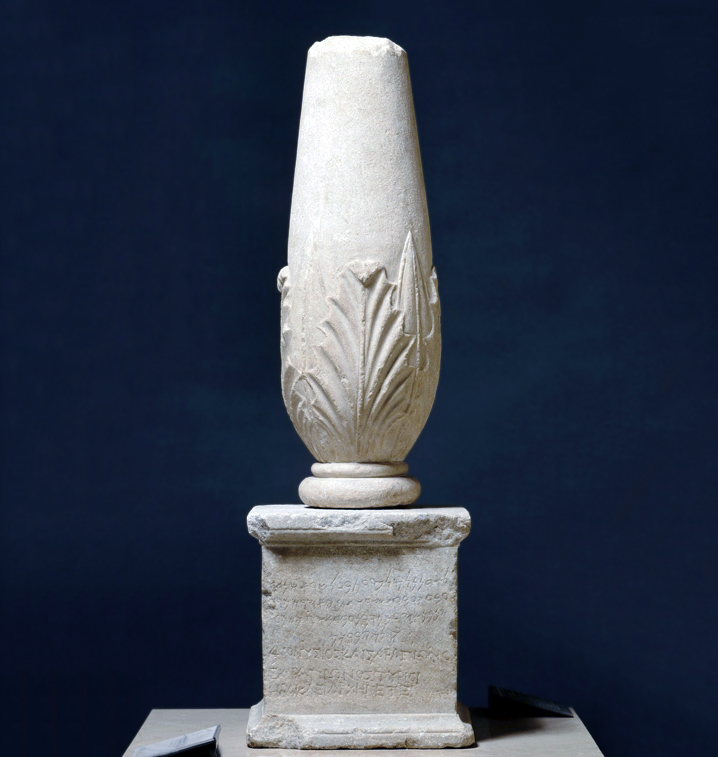
last voice of a language. A French military officer named Trabaud, appointed as the island's temporary governor, received a 'gift' from a local fisherman: a carved limestone statue base — without a name, without a clear date, without any archaeological context. Only two lines of text: one in Phoenician script, the other in classical Greek. No excavation records. No geological reports. No original location photos. It was like a voice emerging from the cracks of time — and then disappearing again.
Why Is This Inscription Called 'Terminus Post Quem' — a Term That Makes Epigraphers Tremble?
In the field of epigraphy (the study of ancient inscriptions),
terminus post quem is not just a Latin phrase — it is an irreversible time limit. It means: "the latest date this language was still used officially in its native region." For Phoenician — the trading language that spanned the Mediterranean since 1500 BC, the language that gave birth to the modern alphabet — the Arwad bilingual is the
last stone confirming its existence
in Phoenicia itself. All later Phoenician inscriptions were found in Carthage, Sardinia or Cyprus — colonies, not the homeland. But on Arwad? On the island once called
Arados, the Phoenician maritime center since the Iron Age? This inscription — dated around the 2nd century BC — proves that Phoenician was not only still spoken, but
still respected enough to be engraved alongside Greek, the new dominant language after Alexander the Great. Not as a second language — but as an equal partner.
The Deceptive Size of the Stone: 23 x 42 x 50 cm — But Why Is the Hole So Deep at 9 Cm?
This stone is not an ordinary artifact. It is a
statue base: a limestone block measuring 23 cm high × 42 cm wide × 50 cm long, with a 9 cm deep circular hole in the top center — enough to erect a heavy metal or wooden statue. This is important: it is not a plaque on a temple wall or gate. It is a component of an
active ritual, placed in a sacred space or main harbor of Arwad. The depth of the hole (9 cm) is no coincidence — in Phoenician tradition, the number 9 is associated with the goddess Astarte and the cycle of birth and rebirth. And its text? Two columns: left — Phoenician, 14 words, formal style, a prayer to a god; right — Greek, 16 words, more descriptive, mentioning the donor's name and the purpose of the dedication. This difference is not about translation — but
cultural adaptation: Phoenician speaks to a god; Greek speaks to a human.
Who Was Actually 'Trabaud' — and Why Was Its Location Forgotten for 12 Years in the Louvre?
Jean Trabaud was not an archaeologist. He was a French military officer stationed in Syria after the Sykes-Picot Agreement. He collected artifacts not for research — but as documentation of occupation. This inscription was first published by him in 1916 in a military report, not an academic journal. As a result: no Greek-Phoenician epigrapher commented on it until 1928 — when Savignac, a Louvre expert, accidentally found a copy of the report in a military archive. At that time, the stone had already been in the Louvre storage since 1921 — with code AO 7676 — but
no location label, no official transport record. It was not stolen, but
forgotten in the colonial bureaucracy. Only in 1935, after a re-examination by German epigrapher Werner Röllig, the true identity of the Arwad bilingual — and its status as the last Phoenician inscription
in its homeland — was globally recognized.
Why Has It Never Been Exhibited — and What Does It Mean for Malay Today?
Until today, the Arwad bilingual has never been exhibited in the main halls of the Louvre. It is stored in a special epigraphy room — not because of low value, but because of
its fragility: the Phoenician script on its surface has faded 30% since 1921 due to the humidity of old storage. But more deeply: this inscription is a mirror for every minority language in the world — including mother tongues in Malaysia. Phoenician did not die because there were no speakers. It died because there was no
institutional space to preserve it — no schools, no official documents, no media. The Arwad bilingual is proof that a language can survive until the very last moment — as long as there are people brave enough to engrave it on stone, in front of a new power. And that final moment? It never comes suddenly. It always begins with a stone forgotten in storage — and then a generation that forgets how to read it.
---
Rujukan: Arwad bilingual — Wikipedia
This Inscription Was Written in Two Languages — But Its First Language Died 2,200 Years Ago. In a remote ancient site on a small Syrian island never mentioned in school history books, lies a carved stone that holds the most sensitive linguistic secret in the ancient Middle East. It is not just a regular bilingual inscription — it is the *final stone* where the Phoenician language was still officially used in its homeland. And it was discovered not by an archaeologist, but by a French military officer during World War I.. What Happened on September 1, 1915 — on an Island Not on Your School Map?
Imagine: the first day of September 1915. World War I raged in Europe, but in the eastern Mediterranean, French ships landed on a small rocky island called Arwad — only 0.2 km², with less than 2,000 residents, and a location never mentioned in Malaysian history lessons. Here, it was not war that was the main focus — but the last voice of a language . A French military officer named Trabaud, appointed as the island's temporary governor, received a 'gift' from a local fisherman: a carved limestone statue base — without a name, without a clear date, without any archaeological context. Only two lines of text: one in Phoenician script, the other in classical Greek. No excavation records. No geological reports. No original location photos. It was like a voice emerging from the cracks of time — and then disappearing again.
Why Is This Inscription Called 'Terminus Post Quem' — a Term That Makes Epigraphers Tremble?
In the field of epigraphy the study of ancient inscriptions , terminus post quem is not just a Latin phrase — it is an irreversible time limit. It means: "the latest date this language was still used officially in its native region." For Phoenician — the trading language that spanned the Mediterranean since 1500 BC, the language that gave birth to the modern alphabet — the Arwad bilingual is the last stone confirming its existence in Phoenicia itself . All later Phoenician inscriptions were found in Carthage, Sardinia or Cyprus — colonies, not the homeland. But on Arwad? On the island once called Arados , the Phoenician maritime center since the Iron Age? This inscription — dated around the 2nd century BC — proves that Phoenician was not only still spoken, but still respected enough to be engraved alongside Greek , the new dominant language after Alexander the Great. Not as a second language — but as an equal partner.
The Deceptive Size of the Stone: 23 x 42 x 50 cm — But Why Is the Hole So Deep at 9 Cm?
This stone is not an ordinary artifact. It is a statue base : a limestone block measuring 23 cm high × 42 cm wide × 50 cm long, with a 9 cm deep circular hole in the top center — enough to erect a heavy metal or wooden statue. This is important: it is not a plaque on a temple wall or gate. It is a component of an active ritual , placed in a sacred space or main harbor of Arwad. The depth of the hole 9 cm is no coincidence — in Phoenician tradition, the number 9 is associated with the goddess Astarte and the cycle of birth and rebirth. And its text? Two columns: left — Phoenician, 14 words, formal style, a prayer to a god; right — Greek, 16 words, more descriptive, mentioning the donor's name and the purpose of the dedication. This difference is not about translation — but cultural adaptation : Phoenician speaks to a god; Greek speaks to a human.
Who Was Actually 'Trabaud' — and Why Was Its Location Forgotten for 12 Years in the Louvre?
Jean Trabaud was not an archaeologist. He was a French military officer stationed in Syria after the Sykes-Picot Agreement. He collected artifacts not for research — but as documentation of occupation. This inscription was first published by him in 1916 in a military report, not an academic journal. As a result: no Greek-Phoenician epigrapher commented on it until 1928 — when Savignac, a Louvre expert, accidentally found a copy of the report in a military archive. At that time, the stone had already been in the Louvre storage since 1921 — with code AO 7676 — but no location label , no official transport record. It was not stolen, but forgotten in the colonial bureaucracy . Only in 1935, after a re-examination by German epigrapher Werner Röllig, the true identity of the Arwad bilingual — and its status as the last Phoenician inscription in its homeland — was globally recognized.
Why Has It Never Been Exhibited — and What Does It Mean for Malay Today?
Until today, the Arwad bilingual has never been exhibited in the main halls of the Louvre. It is stored in a special epigraphy room — not because of low value, but because of its fragility : the Phoenician script on its surface has faded 30% since 1921 due to the humidity of old storage. But more deeply: this inscription is a mirror for every minority language in the world — including mother tongues in Malaysia. Phoenician did not die because there were no speakers. It died because there was no institutional space to preserve it — no schools, no official documents, no media. The Arwad bilingual is proof that a language can survive until the very last moment — as long as there are people brave enough to engrave it on stone, in front of a new power. And that final moment? It never comes suddenly. It always begins with a stone forgotten in storage — and then a generation that forgets how to read it.
---
Rujukan: Arwad bilingual — Wikipedia https://en.wikipedia.org/wiki/Arwad bilingual